1978 Carnival Festivale Cruise Brochure: Deck Plans, Prices & Itineraries
Long before today’s enormous Carnival cruise ships, the company was building its “Fun Ship” identity with converted ocean liners sailing weeklong Caribbean cruises from Miami. This original 1978 Carnival brochure captures that era in remarkable detail, introducing the TSS Festivale and showing its deck plans, cabin prices, onboard amenities and Caribbean itineraries.
Festivale was Carnival Cruise Line’s third ship. Originally built as Transvaal Castle and later known as S.A. Vaal, the vessel was extensively rebuilt before entering Carnival service in 1978. Carnival’s historical records describe the conversion as a $30 million refurbishment and identify Festivale as the largest and fastest cruise ship sailing from Miami to the Caribbean when she entered service.
The original brochure reproduced here is particularly interesting because it shows exactly how Carnival marketed a cruise vacation in 1978 — including fares starting at $435 per person, a casino, nightclubs, midnight buffets, two swimming pools and seven-night Caribbean itineraries.
For more Carnival information, CruisePrism readers can also explore our Carnival Dining Menus, Carnival Drink Lists, and Carnival Onboard Guides for more information about restaurants, schedules and onboard activities.
Introducing the TSS Festivale in 1978
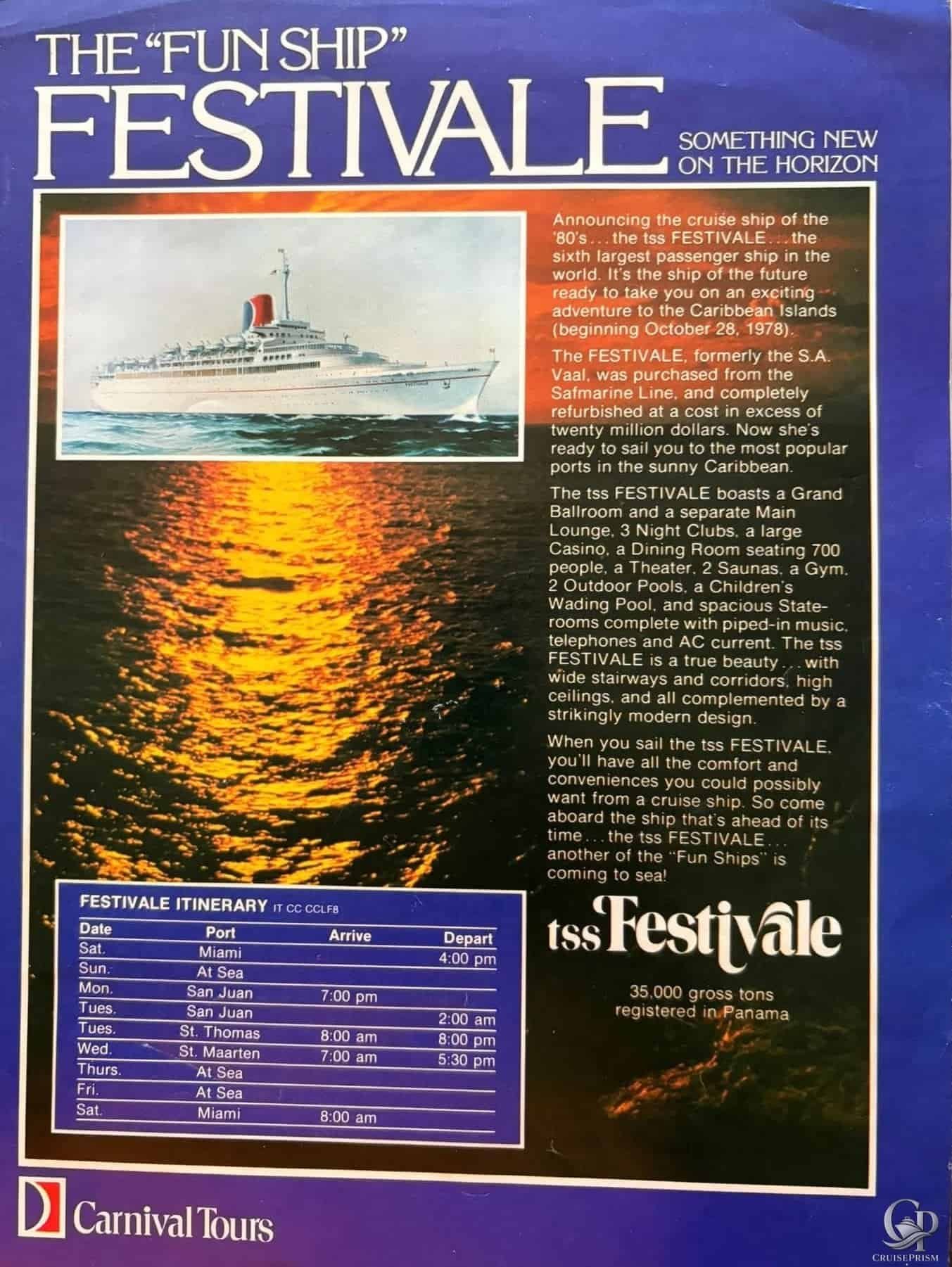
The brochure announces Festivale as “something new on the horizon” and promotes the ship as Carnival’s newest Fun Ship.
At the time, Carnival was still a very young cruise line. It had begun operations in 1972 with Mardi Gras and expanded with Carnivale before adding Festivale in 1978.
Festivale was not a newly constructed cruise ship. She had been built in 1961 as Transvaal Castle and subsequently sailed as S.A. Vaal. Carnival acquired the vessel and extensively converted her for the growing Caribbean cruise market.
The historical brochure describes her as a 35,000-gross-ton ship registered in Panama and promotes her as the sixth-largest passenger ship in the world at the time.
Carnival’s own historical timeline records a $30 million refurbishment before Festivale entered service. The brochure itself says the conversion cost “in excess of twenty million dollars,” providing an interesting contemporary snapshot of how Carnival described the investment to prospective passengers.
What Was Carnival Festivale Like?
The original advertisement provides a surprisingly detailed overview of the ship.
Carnival promoted amenities including:
• A grand ballroom
• A separate main lounge
• Three nightclubs
• A large casino
• A dining room seating 700 passengers
• A theater
• Two saunas
• A gym
• Two outdoor swimming pools
• A children’s wading pool
The brochure also emphasizes features that would hardly warrant a mention on a modern cruise ship, including piped-in music, telephones and air conditioning in the staterooms.
That makes the document particularly valuable as a piece of cruise history. What Carnival considered worth advertising in 1978 provides a window into passenger expectations at the beginning of the modern mass-market cruise era.
The Original 1978 Festivale Caribbean Itinerary
The brochure advertised a seven-night Caribbean cruise beginning and ending in Miami.
The schedule shown was:
• Saturday: Depart Miami at 4:00 PM
• Sunday: At sea
• Monday: Arrive San Juan at 7:00 PM
• Tuesday: Depart San Juan at 2:00 AM
• Tuesday: St. Thomas from 8:00 AM to 8:00 PM
• Wednesday: St. Maarten from 7:00 AM to 5:30 PM
• Thursday: At sea
• Friday: At sea
• Saturday: Arrive Miami at 8:00 AM
This itinerary is particularly interesting compared with modern Caribbean cruise schedules. Festivale spent an evening in San Juan, remaining there until 2:00 AM, followed by full port days in St. Thomas and St. Maarten.
The cruise also included three full days at sea.
The brochure announced that Festivale would begin these Caribbean cruises on October 28, 1978.
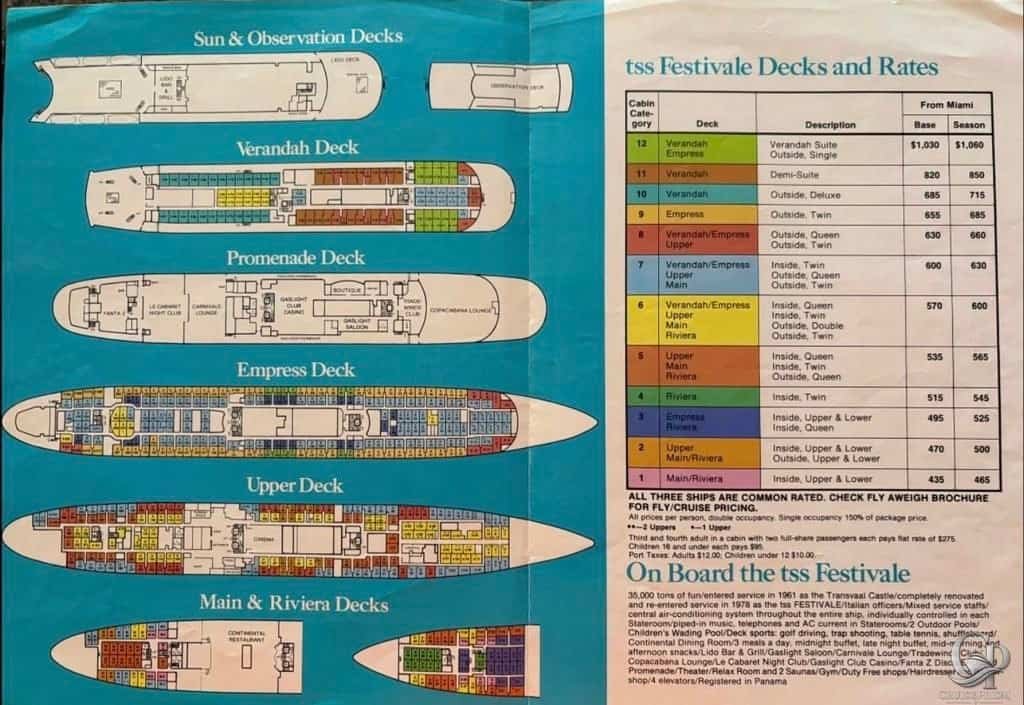
Original Carnival Festivale Deck Plans
The second historical image contains one of the most useful surviving pieces of information for cruise enthusiasts: a complete set of Festivale deck plans.
The plans identify the ship’s principal passenger decks as:
• Sun & Observation Decks
• Verandah Deck
• Promenade Deck
• Empress Deck
• Upper Deck
• Main Deck
• Riviera Deck
The difference between this layout and a modern Carnival cruise ship is dramatic.
Rather than a towering vessel with numerous passenger decks and long rows of balcony cabins, Festivale retained the proportions and internal arrangement of a converted mid-century ocean liner.
Public Rooms on Festivale
The deck plans identify a variety of entertainment and social venues.
Promenade Deck contained several of the ship’s major public spaces, including:
• Carnivale Lounge
• Gaslight Club Casino
• Gaslight Saloon
• Boutique
• Trade Winds Club
• Copacabana Lounge
• Le Cabaret Night Club
Other spaces shown throughout the ship include:
• Cinema
• Continental Restaurant
• Fantá Z Disco
• Enclosed Promenade
• Theater
• Relax Room
• Two saunas
• Gym
• Duty-free shops
• Hairdresser and barber
The ship also had outdoor pools, including a children’s wading pool.
This concentration of lounges, clubs, dancing and entertainment venues illustrates how important onboard entertainment already was to Carnival’s developing Fun Ship concept.
Carnival Festivale Cabin Prices in 1978
The brochure includes a complete fare chart for cruises departing Miami.
It states that prices were per person based on double occupancy.
The least expensive Category 1 inside cabin was:
• Base fare: $435
• Seasonal fare: $465
From there, fares increased according to cabin location and category.
Category 2 accommodations started at $470 base and $500 seasonal, while Category 3 started at $495 and $525.
Midrange categories included:
• Category 4: $515 base / $545 seasonal
• Category 5: $535 base / $565 seasonal
• Category 6: $570 base / $600 seasonal
• Category 7: $600 base / $630 seasonal
• Category 8: $630 base / $660 seasonal
• Category 9: $655 base / $685 seasonal
• Category 10: $685 base / $715 seasonal
Higher-end accommodations became considerably more expensive.
The Category 11 Verandah Demi-Suite was:
• $820 base
• $850 seasonal
At the top was the Category 12 Verandah Suite, described as an outside single:
• $1,030 base
• $1,060 seasonal
Remember that these are 1978 dollars, so a direct numerical comparison with modern Carnival fares would be misleading without adjusting for inflation.
What Was Included in the 1978 Fare?
The brochure describes a cruise experience that already contained many elements passengers would recognize today.
It lists:
• Three meals per day in the Continental Dining Room
• Midnight buffet
• Late-night buffet
• Mid-morning snacks
• Afternoon snacks
It also advertises the ship’s pools, lounges, casino, disco, nightclubs, cinema, gym and other facilities.
The document states that port taxes were $12 for adults and $10 for children.
Children age 16 and under were listed at $95 under the brochure’s applicable occupancy arrangement, while additional adult passengers sharing a cabin were charged a flat rate of $275.
Single occupancy was priced at 150% of the package price.
These conditions belonged specifically to the historical fare structure advertised in this brochure.
A Cruise Ship Built for Entertainment
One of the most striking parts of this document is how familiar Carnival’s basic sales pitch already sounds.
The technology and ship were completely different, but Carnival was emphasizing entertainment, nightlife, food, pools and social activities.
Festivale had a disco, casino, multiple nightclubs, lounges, a cinema and a theater.
This was not accidental. Carnival’s early strategy increasingly emphasized the ship itself as an important part of the vacation rather than treating it simply as transportation between Caribbean islands.
Festivale became particularly significant in that development. Historical accounts of the ship’s conversion describe extensive work to transform the former liner for Carnival’s entertainment-focused cruise product.
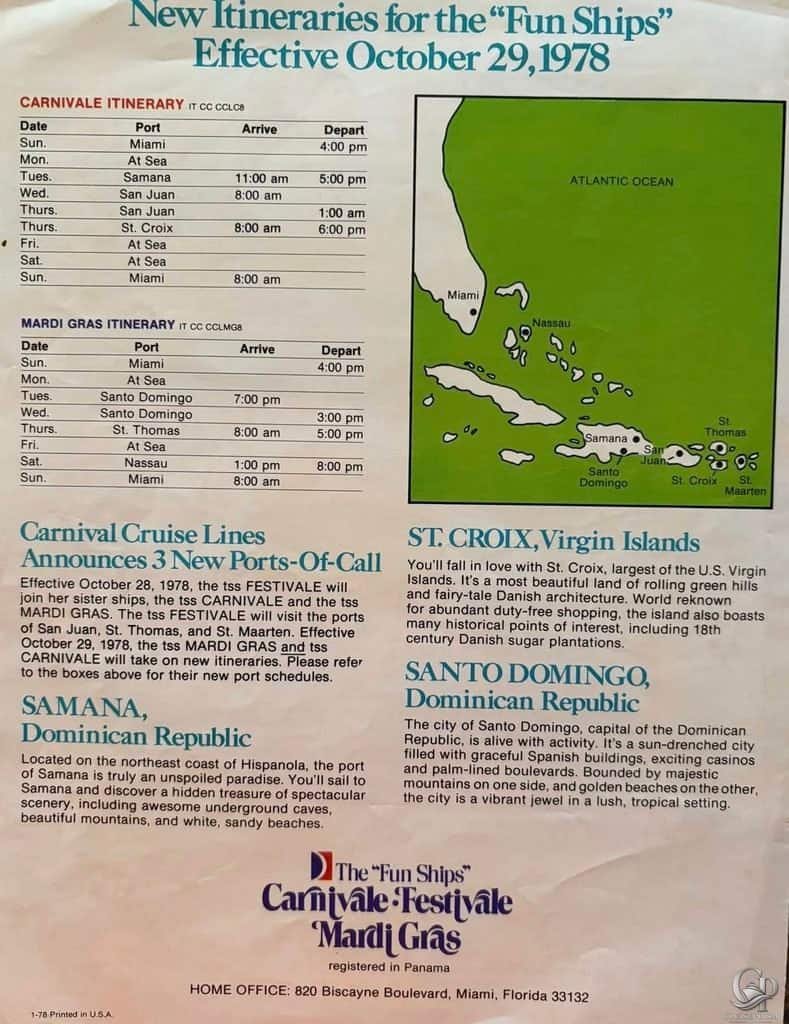
Carnival’s New Caribbean Itineraries for 1978
Another page of the historical material announces “New Itineraries for the ‘Fun Ships’ Effective October 29, 1978.”
This page places Festivale into the broader context of Carnival’s tiny 1978 fleet.
The document states that Festivale was joining sister ships Carnivale and Mardi Gras.
Carnival announced three new ports of call: Samaná, St. Croix and St. Maarten.
Festivale was assigned the itinerary featuring San Juan, St. Thomas and St. Maarten, while the brochure shows different schedules for Carnivale and Mardi Gras.
Carnivale’s 1978 Itinerary
The Carnivale itinerary shown in the brochure departed Miami on Sunday and included:
• Miami
• Sea day
• Samaná
• San Juan
• St. Croix
• Two additional sea days
• Return to Miami
The itinerary included an overnight-style visit to San Juan, arriving Wednesday morning and departing at 1:00 AM Thursday.
Mardi Gras’ 1978 Itinerary
Mardi Gras followed another route:
• Miami
• Sea day
• Santo Domingo
• St. Thomas
• Sea day
• Nassau
• Miami
The ship arrived in Santo Domingo at 7:00 PM on Tuesday and remained until 3:00 PM Wednesday.
Nassau was scheduled from 1:00 PM until 8:00 PM on Saturday before the ship returned to Miami at 8:00 AM Sunday.
These schedules provide a fascinating record of Carnival’s Caribbean operations when the company had only three ships.
How Carnival Promoted Caribbean Destinations
The brochure also includes destination descriptions for Samaná and Santo Domingo.
Samaná was promoted for its scenery, caves, mountains and beaches, while Santo Domingo was marketed around its Spanish architecture, casinos, palm-lined boulevards, mountains and beaches.
St. Croix was promoted for shopping, Danish architecture and historic sugar plantations.
The language is unmistakably from a 1970s tourism brochure, but the underlying strategy remains familiar: combine the attractions of the ship with the appeal of several distinct Caribbean destinations.
Festivale and the Growth of Carnival Cruise Line
Festivale occupies an important place in Carnival history.
When Carnival was founded in 1972, the company did not have the enormous purpose-built fleet associated with the brand today. Its early ships were existing passenger liners adapted for cruising.
Mardi Gras came first, followed by Carnivale and then Festivale.
Carnival’s historical records say Festivale entered service in 1978 after a $30 million refurbishment and became the largest and fastest vessel then sailing from Miami to the Caribbean.
The success of these early converted ships helped Carnival move into a new phase.
In 1982, Tropicale entered service as Carnival’s first purpose-built new cruise ship. From there, the fleet expanded rapidly through the 1980s and beyond.
Festivale therefore represents a transitional moment: an older ocean liner extensively transformed to serve a new kind of mass-market vacation.
The Festivale Name Returns to Carnival
There is another reason this historical brochure has renewed relevance.
Carnival is bringing the Festivale name back.
The modern Carnival Festivale is an entirely different vessel from the 1978 ship, but its name deliberately revives one of the important names from Carnival’s early history.
That creates an extraordinary contrast between generations of cruise ships.
The original Festivale brochure advertised a 35,000-gross-ton converted ocean liner as one of the world’s largest passenger ships. Modern Carnival ships are vastly larger and offer a scale of accommodations, restaurants, entertainment and onboard attractions that would have been difficult to imagine when this brochure was printed.
Yet the basic Carnival idea visible in this document — make the ship itself a major part of the vacation — remains recognizable decades later.
A Snapshot of Cruising in the Late 1970s
Historical cruise brochures are valuable because they preserve details that broad histories of a cruise line often overlook.
The cabin prices tell us what passengers were being asked to pay.
The deck plans show how the ship was physically organized.
The itinerary reveals how long ships stayed in port.
The amenity list shows what Carnival believed passengers valued.
And the advertising language reveals how the cruise line wanted travelers to imagine the experience.
In 1978, having air-conditioned cabins with telephones and piped-in music was worth highlighting. A ship with two outdoor pools, several nightclubs, a casino, theater and gym could be promoted as the cruise ship of the future.
Today those details make the brochure even more interesting.
Comparing the Original Festivale With Modern Cruise Ships
The final image provides a visual reminder of just how dramatically cruise ships have changed.
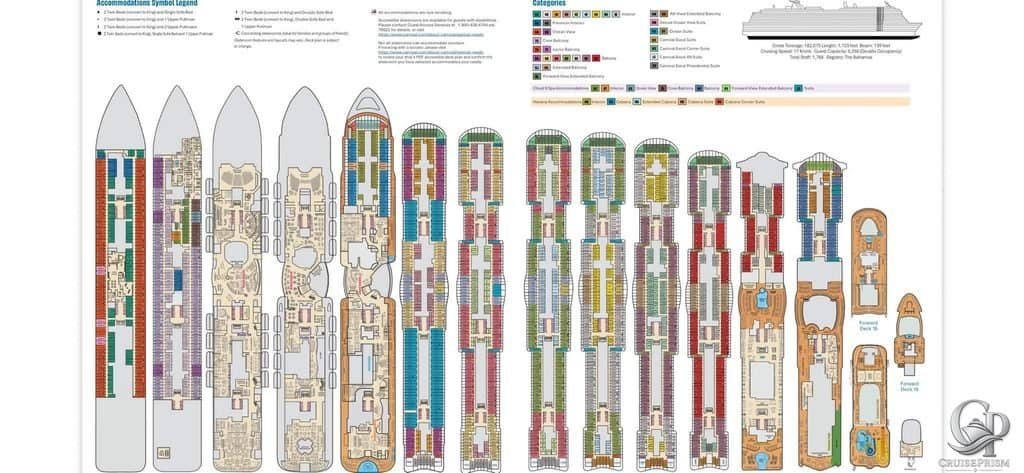
Modern Carnival ships use a completely different scale and layout from Festivale.
The original Festivale deck plan is relatively compact, with passenger accommodations spread across several traditional decks and major public rooms concentrated in specific sections of the ship.
A contemporary Carnival deck plan can extend across many more passenger decks, with large numbers of balcony cabins and suites alongside expansive dining, entertainment and recreation areas.
The comparison should not be interpreted as a deck plan of the original Festivale. The fourth image represents a modern Carnival cruise ship and is included solely to illustrate how dramatically Carnival ship design and scale have evolved since the era represented by the 1978 brochure.
Frequently Asked Questions About Carnival Festivale
When did Carnival Festivale enter service?
Festivale entered Carnival Cruise Line service in 1978 after an extensive refurbishment.
Was Festivale originally built for Carnival?
No. The vessel was originally built as Transvaal Castle in 1961 and later sailed as S.A. Vaal before becoming Carnival’s Festivale.
Was Festivale Carnival’s first cruise ship?
No. Carnival began with Mardi Gras in 1972. Carnivale followed, and Festivale became Carnival’s third ship.
How large was the original Carnival Festivale?
The original 1978 brochure describes Festivale as 35,000 gross tons.
How much did a Carnival Festivale cruise cost in 1978?
According to this original brochure, fares from Miami started at $435 per person based on double occupancy. Seasonal pricing for the least expensive category started at $465.
The highest fare shown was $1,060 for the seasonal Category 12 Verandah Suite.
Were there suites on Festivale?
Yes. The brochure lists a Category 11 Verandah Demi-Suite and a Category 12 Verandah Suite.
Did Carnival Festivale have a casino?
Yes. The brochure advertises a large casino, and the deck plan identifies the Gaslight Club Casino on Promenade Deck.
Did Festivale have swimming pools?
Yes. Carnival advertised two outdoor pools plus a children’s wading pool.
Did Festivale have a movie theater?
Yes. The brochure lists a theater among the ship’s facilities, and the deck plan also identifies a cinema.
Where did Carnival Festivale sail in 1978?
The itinerary shown in this brochure departed Miami and visited San Juan, St. Thomas and St. Maarten before returning to Miami.
How long was the Festivale cruise?
The itinerary shown was a seven-night Caribbean cruise departing Miami on Saturday and returning the following Saturday.
What other ships did Carnival operate in 1978?
The brochure identifies Carnival’s three Fun Ships as Festivale, Carnivale and Mardi Gras.
What happened after Carnival’s early Fun Ships?
Carnival subsequently moved toward purpose-built cruise ships. Tropicale became Carnival’s first purpose-built new cruise ship when it entered service in 1982, beginning a major new phase in the company’s development.
Is the new Carnival Festivale the same ship?
No. The modern Carnival Festivale reuses the historic name but is an entirely different ship. The Festivale featured in this article is the original vessel that entered Carnival service in 1978.
Conclusion: An Original Piece of Carnival Cruise History
This 1978 Festivale brochure captures Carnival Cruise Line at a pivotal point in its history.
The company had only three ships. Festivale was being promoted as a major new addition to the fleet, and a seven-night Caribbean cruise from Miami could start at $435 per person.
Yet many elements of the modern cruise experience were already visible.
Passengers had multiple nightclubs, a disco, casino, theater, cinema, pools, gym, shops and an extensive meal schedule. Carnival was not merely selling transportation to San Juan, St. Thomas and St. Maarten. It was selling the experience of being aboard a Fun Ship.
That concept would become central to Carnival’s identity.
The original deck plans, fares and itineraries make this brochure more than a piece of vintage advertising. They preserve a detailed snapshot of what a Carnival cruise looked like in 1978, just before the company began moving from converted ocean liners toward purpose-built modern cruise ships.
More than four decades later, the scale of Carnival cruising has changed almost beyond recognition. But looking back at the original Festivale makes it possible to see where many of the ideas behind the modern Carnival vacation began.