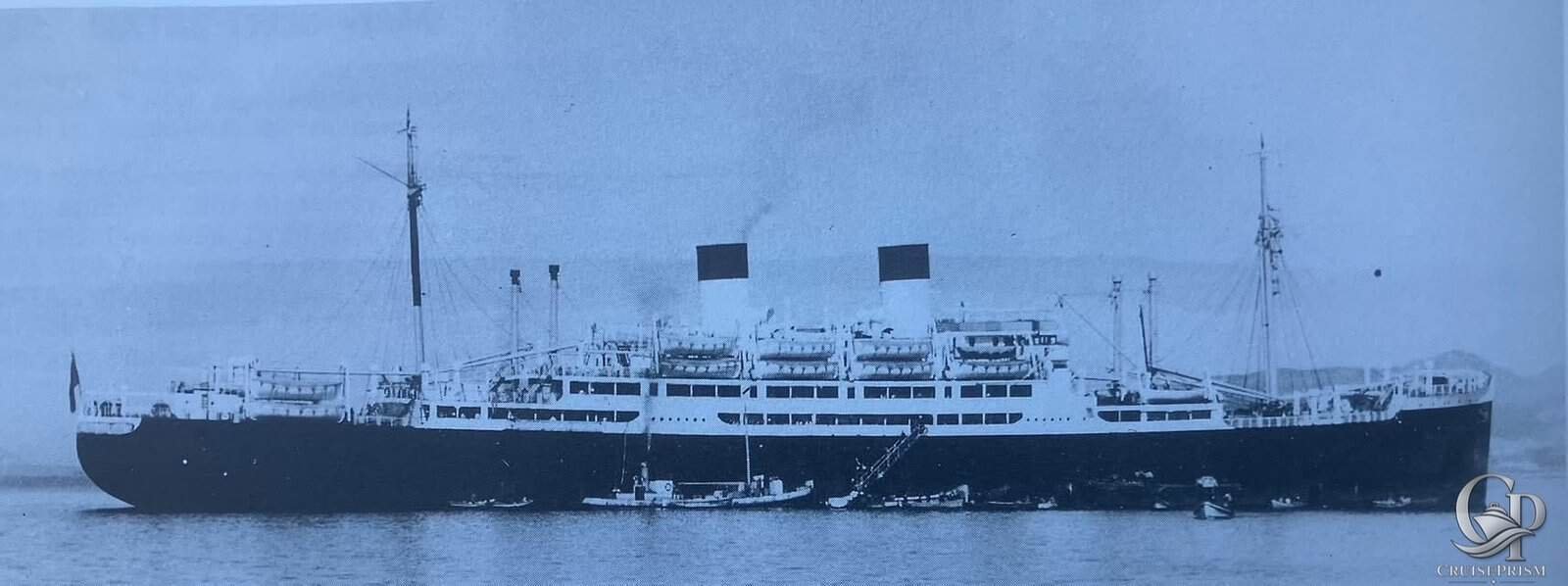
Inside the General Osorio: Original 1929 Deck Plans and Passenger Interiors
Nearly a century before modern cruise ships filled their decks with water parks, specialty restaurants and entertainment venues, passenger ships crossing between Europe and South America had a very different purpose. They carried travelers, immigrants and cargo across the Atlantic on voyages that could last for weeks.
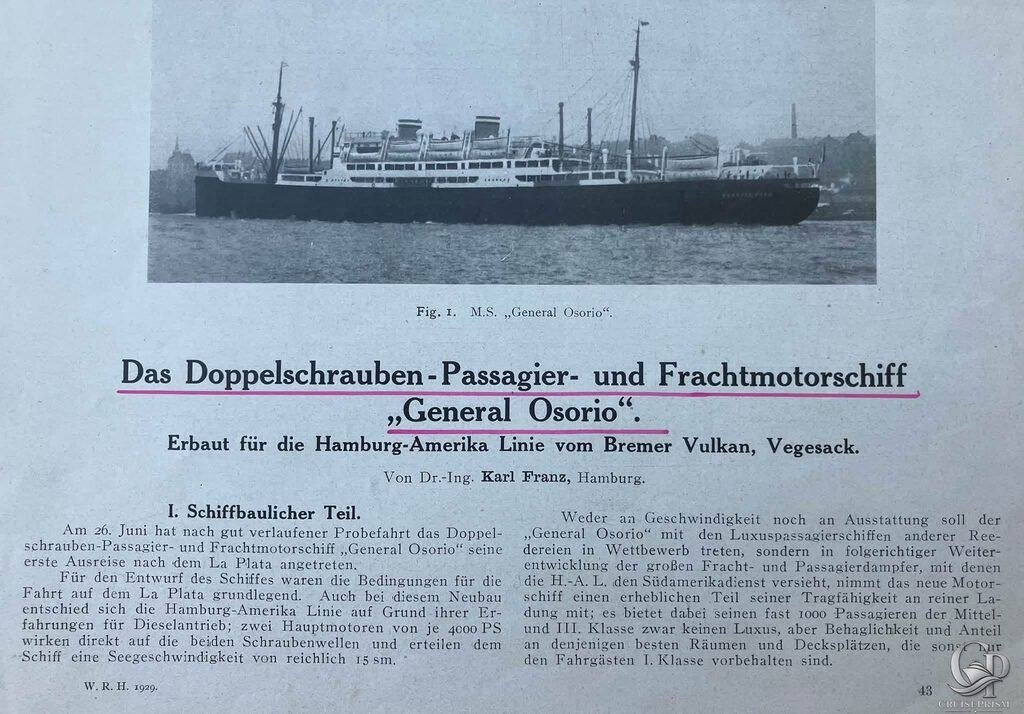
The General Osorio was one of those ships. Built in Germany in 1929 for the Hamburg-America Line, the twin-screw motor ship was designed for the company’s South America service. An original German engineering article published shortly after the ship entered service provides a remarkable contemporary look at the General Osorio, including detailed deck plans, technical drawings and photographs of passenger accommodations.
The surviving pages reproduced here are particularly interesting because they show how the ship was arranged for different passenger classes. They include original images of Middle Class and Third Class cabins, dining rooms, lounges and open decks, providing a rare glimpse of what an Atlantic voyage aboard General Osorio looked like in 1929.
Readers interested in exploring more maritime history on CruisePrism can also visit our [historic ocean liners and cruise ships], [vintage cruise ship deck plans], [history of cruising and ocean travel] and [other cruise lines and historic ships] collections.
What Was the General Osorio?
General Osorio was a German passenger and cargo motor ship built by Bremer Vulkan at Vegesack for the Hamburg-America Line, commonly known as HAPAG.
The title of the original German article translates approximately as:
“The Twin-Screw Passenger and Cargo Motor Ship ‘General Osorio’ — Built for the Hamburg-America Line by Bremer Vulkan, Vegesack.”
The article was written by Dr.-Ing. Karl Franz of Hamburg and published in the German maritime engineering journal Werft, Reederei, Hafen in 1929.
General Osorio entered service in 1929 and was designed for Hamburg-America Line’s service between Europe and the east coast of South America.
The contemporary article states that following successful trials, General Osorio departed on June 26 for her first voyage to the La Plata region.
Rather than attempting to compete directly with the most luxurious express liners of the period, the ship was designed to combine substantial cargo capacity with accommodations for almost 1,000 passengers traveling primarily in Middle Class and Third Class.
That combination makes General Osorio particularly interesting today. She was not simply an ocean liner and not simply a freighter. Passenger accommodations, public rooms, machinery and large cargo spaces all had to coexist within the same vessel.
Original General Osorio Deck Plans
One of the most valuable surviving elements of the 1929 article is an exceptionally detailed set of General Osorio deck plans.
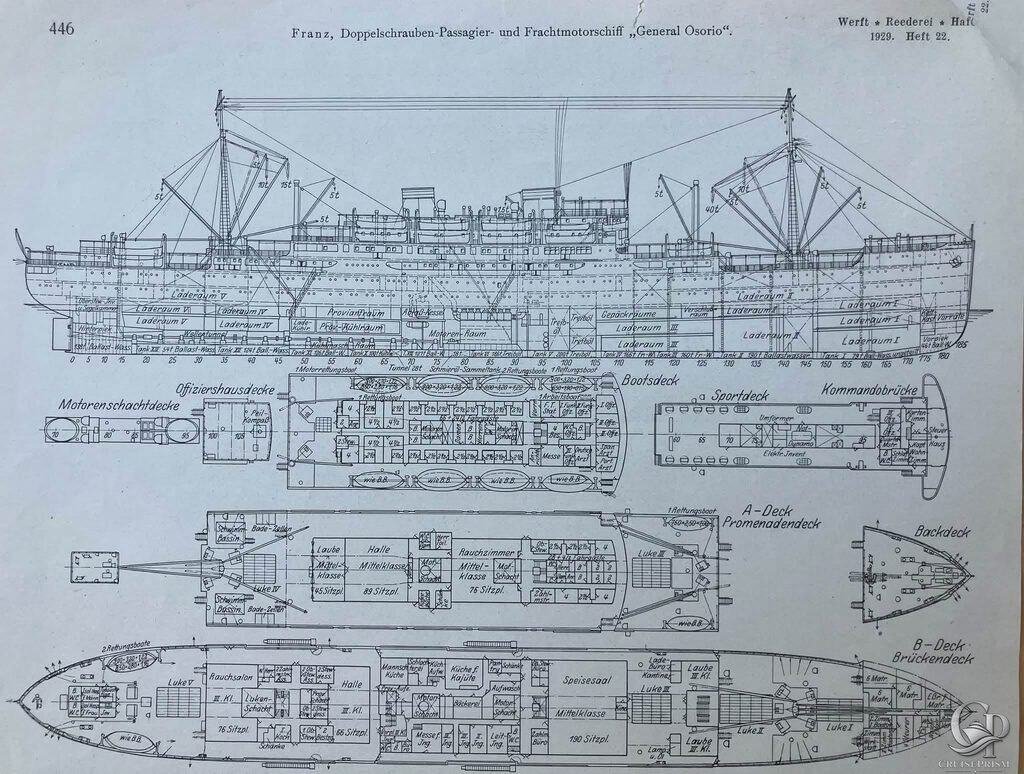
The drawing provides both a longitudinal profile of the vessel and plans for several of its upper decks.
Unlike the simplified deck plans commonly provided to passengers today, this was an engineering publication. The drawings identify passenger spaces alongside working areas of the ship, including cargo holds, machinery spaces and service areas.
The plans show just how much of General Osorio was devoted to carrying cargo. Large holds occupy substantial portions of the vessel forward and aft, while the machinery spaces sit near the center of the ship.
Passenger accommodations were distributed through the decks above and around these working areas.
The plans also identify spaces such as dining rooms, lounges and passenger cabins, allowing modern readers to understand how travelers actually moved through the ship.
A Deck-by-Deck Look at General Osorio
The additional deck plans reveal even more of the vessel’s internal organization.
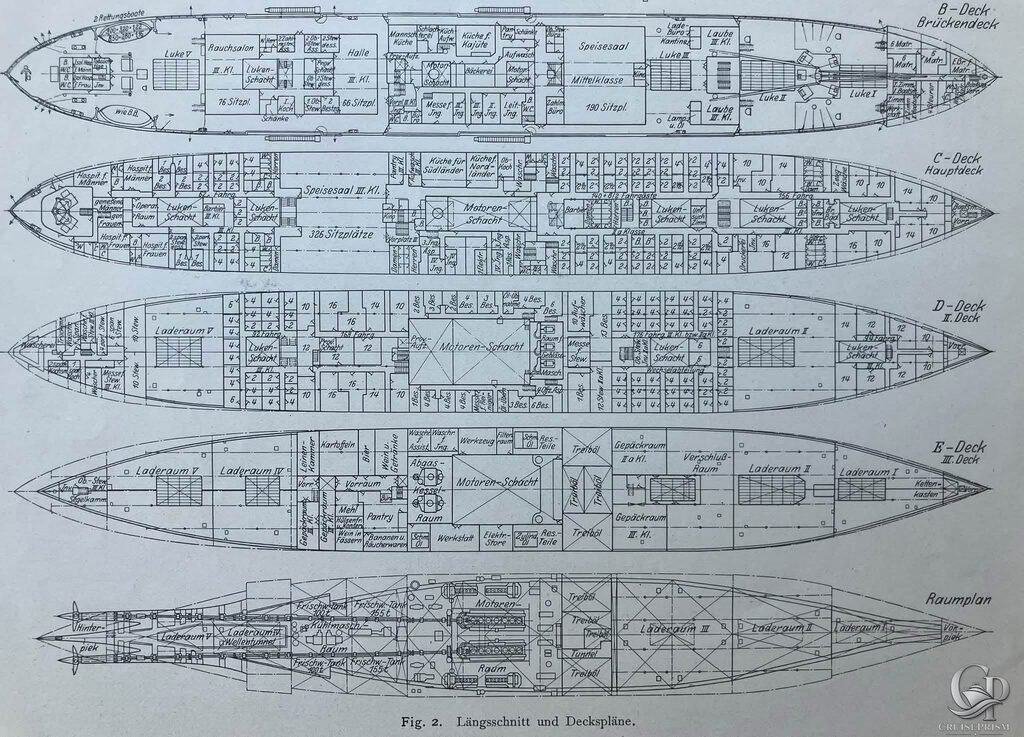
The drawings include the B-Deck, C-Deck, D-Deck and E-Deck, as well as a lower internal arrangement.
The difference from a modern cruise ship deck plan is immediately apparent.
General Osorio was fundamentally a working passenger-cargo vessel. Passenger cabins shared the ship with enormous cargo holds, machinery spaces, storage areas, service rooms and crew accommodations.
The original plans identify five cargo holds distributed forward and aft of the machinery spaces.
The C-Deck plan is especially revealing because large numbers of passenger cabins can be seen arranged along corridors surrounding the central machinery casing.
The plans also illustrate the separation between passenger classes that was normal aboard ocean liners of this period.
Modern cruise ships generally sell different categories of cabins while allowing most guests to use the same principal restaurants, lounges and entertainment spaces. Ships of General Osorio’s era could physically separate passengers according to their class of passage, providing each class with its own accommodations and public spaces.
General Osorio’s Size and Technical Specifications
The engineering article includes detailed construction drawings and the ship’s principal measurements.
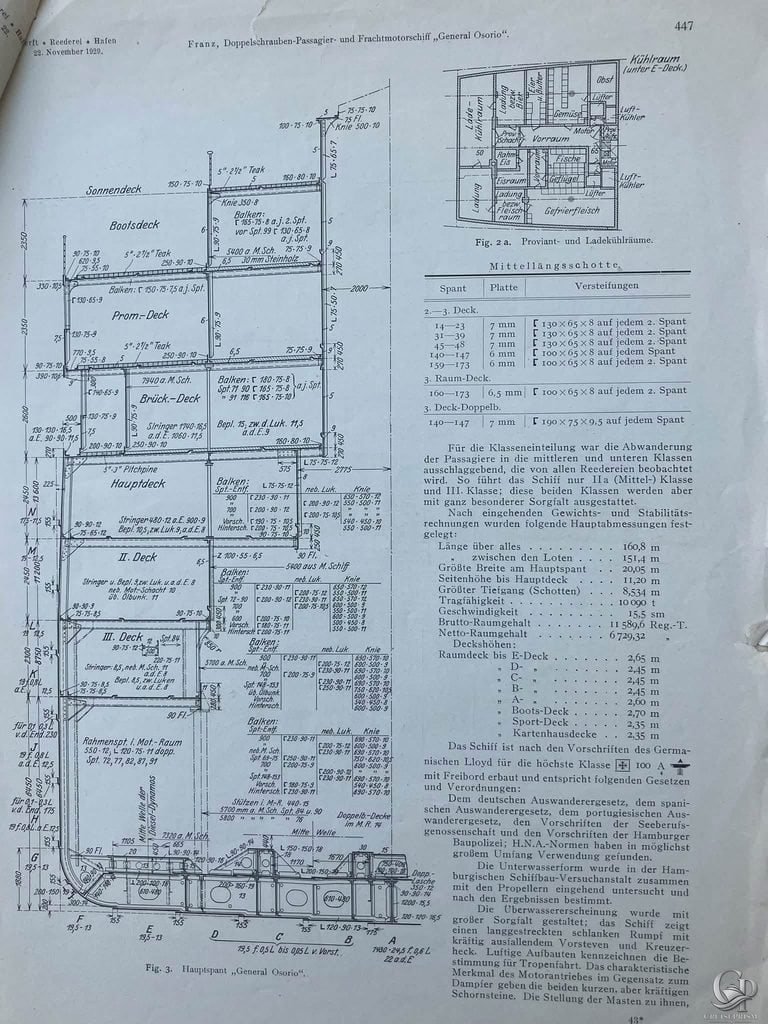
According to the contemporary document, General Osorio measured approximately:
• 160.8 meters in overall length
• 151.4 meters between perpendiculars
• 20.05 meters in maximum breadth
• 11.20 meters in side height
• 8.534 meters maximum draft
• 10,000 metric tons deadweight
• 15.5 knots in speed
• 11,580.6 gross register tons
• 6,729.32 net register tons
The ship used diesel propulsion driving two propellers, which explains the original article’s description of General Osorio as a “Doppelschrauben” or twin-screw motor ship.
The technical drawing also illustrates the vertical relationship between the decks, from the lower portions of the hull through the passenger decks and upper superstructure.
Another drawing shows refrigerated provision and cargo spaces, with separate areas labeled for items including fish, meat, poultry, vegetables, fruit and other provisions or cargo requiring temperature-controlled storage.
This was an important capability for a ship designed to combine passenger service with long-distance commercial cargo operations.
How Many Passengers Could General Osorio Carry?
The original article describes accommodations for approximately 234 Middle Class passengers and 750 Third Class passengers.
That meant the overwhelming majority of the ship’s passenger capacity was devoted to travelers outside the luxury market.
The article explains that Middle Class passengers could be accommodated in two- and four-berth cabins.
Third Class capacity was considerably larger, with hundreds of passengers accommodated in cabins of varying sizes.
The original deck plans show just how extensive these accommodations were, particularly on the lower passenger decks.
But numbers alone do not communicate what traveling aboard General Osorio would actually have felt like.
Fortunately, the article also included photographs.
Inside General Osorio’s Middle Class Accommodations
The surviving photographs of General Osorio’s Middle Class spaces provide an unusually clear view of passenger life aboard a German liner in the late 1920s.
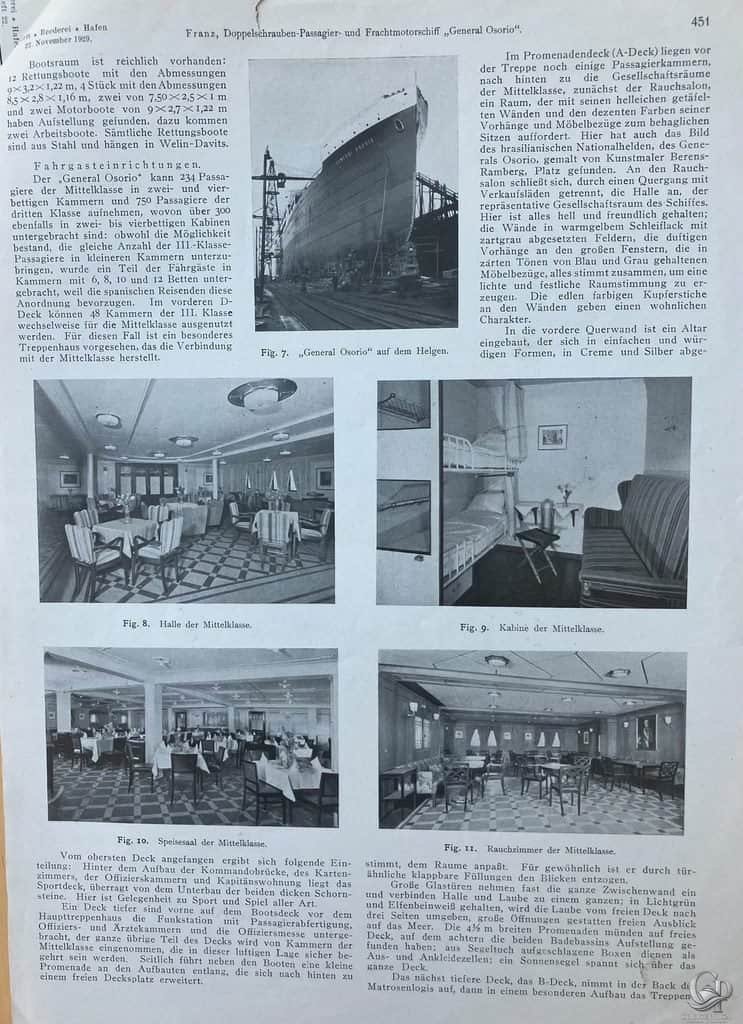
The page contains four important interior photographs in addition to an image of the ship during construction.
They are identified in the original article as:
• General Osorio on the slipway
• Middle Class hall
• Middle Class cabin
• Middle Class dining room
• Middle Class smoking room
The Middle Class hall appears surprisingly comfortable for accommodations that were not marketed as the ship’s highest luxury category.
Tables and upholstered chairs occupy a spacious room with patterned flooring, framed artwork and large windows.
The Middle Class cabin presents a very different environment.
Space was clearly at a premium. The photograph shows bunk-style sleeping arrangements alongside an upholstered bench or sofa, a small table and basic furnishings.
For travelers familiar with today’s cruise ship cabins, the photograph provides a fascinating comparison. The accommodations were functional and compact, but passengers had access to considerably larger communal spaces elsewhere aboard the ship.
Dining Aboard General Osorio
Dining arrangements were also divided according to passenger class.
The Middle Class dining room shown in the original photographs is a substantial space filled with individual tables and chairs.
The engineering plans identify the Middle Class dining room on B-Deck and indicate seating for 190 passengers.
The layout reflects an important difference between historical ocean liners and modern cruising.
For General Osorio, the primary purpose of the voyage was transportation across the Atlantic. Dining rooms, lounges and promenades were essential because passengers would spend extended periods aboard while traveling between Europe and South America.
These weren’t short recreational cruises built around daily port excursions. The ship itself had to provide livable accommodations during a lengthy ocean passage.
The Middle Class Smoking Room
Another photograph identifies the Rauchzimmer der Mittelklasse, or Middle Class smoking room.
The room contains tables, chairs, patterned flooring and wood-paneled walls, creating the atmosphere of a traditional club or lounge.
Dedicated smoking rooms were common features of passenger liners during this period.
Together with the hall and dining room, the photograph demonstrates that Middle Class passengers had several communal areas outside their cabins.
The original article also describes promenades and access to open deck areas, giving passengers places to spend time outdoors during the crossing.
What Was Third Class Like on General Osorio?
The next page provides an even more valuable comparison: actual photographs of Third Class accommodations.
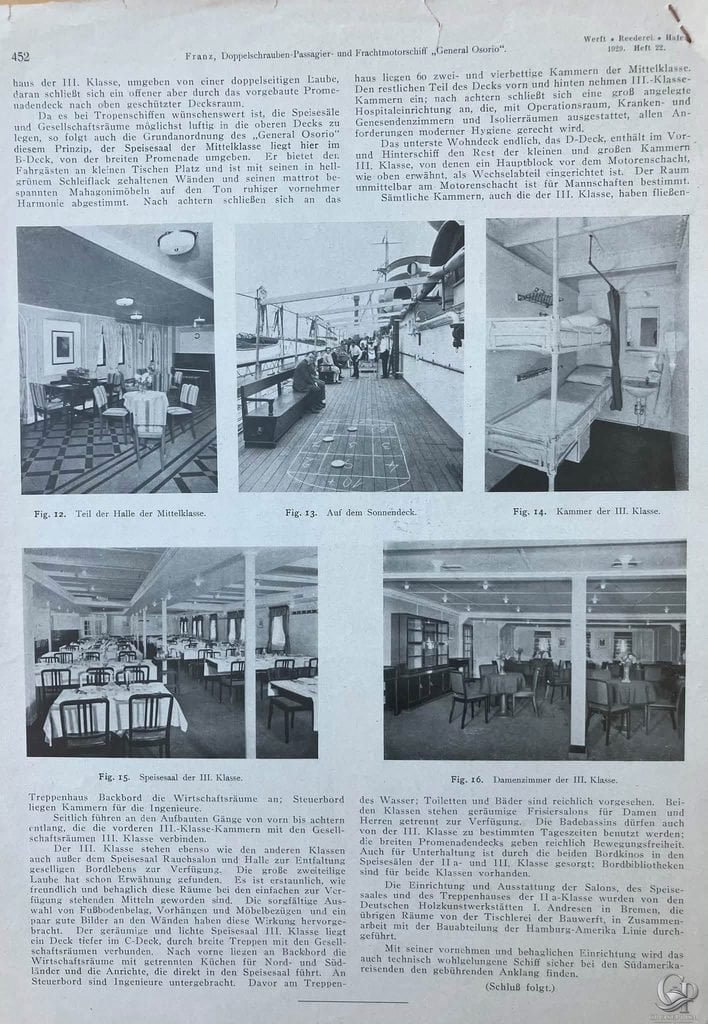
The photographs are identified as:
• Part of the Middle Class hall
• Sun deck
• Third Class cabin
• Third Class dining room
• Third Class ladies’ room
The Third Class cabin is particularly revealing.
Multiple bunk beds occupy a relatively small compartment, with far less furniture and personal space than the Middle Class cabin shown on the preceding page.
This was transportation designed to accommodate large numbers of passengers economically.
Yet Third Class passengers were not confined exclusively to their cabins.
The article shows a sizable Third Class dining room as well as a dedicated ladies’ room or lounge.
The Third Class dining room is considerably more utilitarian than the Middle Class spaces. Long rows of tables and straightforward chairs fill a large open room.
The separate Third Class ladies’ room appears more comfortably furnished, with tables, chairs, cabinets and decorative elements.
Life on the Sun Deck
One of the most evocative photographs in the article shows passengers relaxing on the Sonnendeck, or sun deck.
People sit along the side of a broad wooden deck beneath the ship’s lifeboats and superstructure.
A shuffleboard-style court can be seen painted onto the deck.
It is a scene that would still be recognizable to cruise passengers nearly a century later.
Ships have changed enormously, but the simple appeal of sitting outside at sea and participating in deck activities has survived from the ocean-liner era into modern cruising.
General Osorio and the Europe–South America Route
General Osorio was built specifically for Hamburg-America Line’s South American service.
Contemporary records document the ship operating between Europe and ports on the eastern coast of South America, including Brazilian and River Plate destinations.
A contemporary Brazilian report documented General Osorio’s inaugural visit to Rio de Janeiro in 1929 and described the ship as having been specially constructed for the Europe–South America route.
Period Hamburg-America Line advertisements subsequently promoted General Osorio alongside ships including General Artigas and General San Martin for passenger and cargo service between Europe and South America.
This was an important international transportation corridor.
Before commercial aviation transformed intercontinental travel, ships provided the practical connection between Europe and South America for immigrants, business travelers, tourists, families and cargo.
General Osorio was designed specifically around that market.
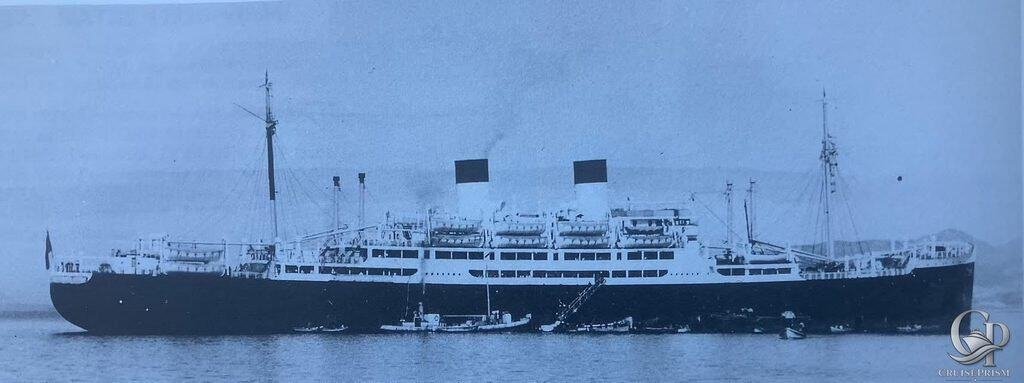
General Osorio’s Later Career
General Osorio’s career eventually extended beyond Hamburg-America Line.
During the restructuring of German shipping services in the 1930s, the vessel moved to Hamburg-Süd, another major German company closely associated with South American routes.
General Osorio continued in South American service and even participated in cruising. Historical records indicate that in 1938 she was used alongside Hamburg-Süd’s passenger operations for a summer cruise from the La Plata region toward Brazilian destinations.
Her career changed completely with the beginning of World War II.
The ship remained in Germany and was subsequently used by the German navy as an accommodation vessel in Kiel.
General Osorio suffered bomb damage during an Allied air raid in July 1944. After being made afloat again and undergoing provisional repairs, she was struck during another air raid on Kiel on April 9, 1945 and sank.
The wreck was eventually raised after the war and taken to Inverkeithing, Scotland, for scrapping in 1947.
A ship created to connect Europe and South America had survived for only about sixteen years.
What Makes These 1929 Documents Important?
Historical ship photographs are relatively easy to understand. Technical documents like these are arguably even more valuable because they preserve information that photographs alone cannot show.
Together, these pages document:
• The external appearance of General Osorio
• Complete deck arrangements
• Cargo holds
• Machinery spaces
• Passenger cabin locations
• Middle Class public rooms
• Third Class public rooms
• Dining facilities
• Passenger cabins
• Open deck spaces
• Refrigerated storage
• Structural dimensions
• Original engineering specifications
They also preserve something more subtle: the social organization of passenger travel in 1929.
Looking at the Middle Class and Third Class deck plans alongside photographs of the actual rooms makes the class system tangible.
The difference wasn’t merely the size of a cabin. Passenger classes had their own dining rooms, lounges, promenades and accommodations distributed through different parts of the vessel.
That makes General Osorio a particularly useful example for understanding how passenger ships operated before the modern cruise industry developed.
General Osorio Compared With a Modern Cruise Ship
Comparing General Osorio with a modern cruise ship requires remembering that the two were created for fundamentally different purposes.
Today’s large cruise ships are primarily vacation destinations. Transportation between ports is only one component of the experience.
General Osorio was primarily a transportation and cargo vessel that also needed to keep nearly 1,000 passengers fed, housed and reasonably comfortable during long-distance ocean travel.
Instead of dozens of restaurants and bars, passengers relied on class-specific dining rooms and public spaces.
Instead of theaters, water parks and elaborate entertainment schedules, the surviving plans emphasize lounges, dining rooms, promenades and open decks.
And beneath the passenger accommodations were enormous cargo spaces that formed a central part of the ship’s commercial purpose.
Yet some elements remain surprisingly familiar.
Passengers gathered in lounges, ate in large dining rooms, walked the promenade, sat outside watching the ocean and played games on deck.
Those basic parts of the passenger experience survived the transition from ocean liners to modern cruise ships.
Frequently Asked Questions About General Osorio
What was General Osorio?
General Osorio was a German twin-screw passenger and cargo motor ship built in 1929 by Bremer Vulkan for the Hamburg-America Line.
When was General Osorio built?
The ship entered service in 1929.
Who built General Osorio?
General Osorio was constructed by Bremer Vulkan at Vegesack, Germany.
Which cruise line owned General Osorio?
General Osorio was originally built for the Hamburg-America Line, or HAPAG. She later operated for Hamburg-Süd.
Where did General Osorio sail?
The ship was designed for service between Europe and the east coast of South America, including Brazil and the River Plate region.
How large was General Osorio?
The contemporary engineering article gives an overall length of approximately 160.8 meters and a maximum breadth of approximately 20.05 meters.
How fast was General Osorio?
The original 1929 document lists a speed of approximately 15.5 knots.
How many passengers did General Osorio carry?
The contemporary article describes accommodations for approximately 234 Middle Class passengers and 750 Third Class passengers.
Did General Osorio have First Class?
The contemporary article emphasizes Middle Class and Third Class passenger accommodations. These surviving pages do not document a conventional First Class passenger section, so this article does not assume one.
What were the cabins like aboard General Osorio?
The surviving photographs show both Middle Class and Third Class cabins. The Middle Class example contains bunk-style beds, an upholstered seating area and additional furnishings. The Third Class example is considerably more basic and contains multiple bunks within a compact cabin.
Did Third Class passengers have dining rooms and lounges?
Yes. The original article includes photographs of a Third Class dining room and a dedicated Third Class ladies’ room, while the deck plans show additional Third Class spaces.
Did General Osorio have recreational activities?
The surviving sun-deck photograph clearly shows a marked deck game area resembling shuffleboard. The documents also show substantial outdoor deck areas and promenades.
What happened to General Osorio?
After later serving Hamburg-Süd, General Osorio remained in Germany during World War II and was used as an accommodation vessel at Kiel. She was damaged by bombing in 1944 and sank following another Allied air raid in April 1945. The wreck was raised after the war and scrapped in 1947.
Are these original General Osorio deck plans?
The plans reproduced here come from a 1929 German engineering article about the newly constructed General Osorio. They show the ship’s profile, deck arrangements, machinery and structural details as documented at the time.

Conclusion
The General Osorio documents offer something that a simple historical photograph cannot: the opportunity to virtually explore a passenger ship built almost a century ago.
The original 1929 plans reveal the ship from the keel upward. Cargo holds, machinery spaces, passenger cabins, dining rooms and lounges can all be located within the vessel. Contemporary photographs then bring several of those spaces to life.
Most fascinating is the comparison between Middle Class and Third Class travel. The documents show not only where each group slept but where passengers ate, socialized and spent their time during a transatlantic voyage.
General Osorio belonged to an era when passenger ships were essential links between continents rather than floating resorts. Yet photographs of passengers relaxing on the sun deck, gathering in lounges and dining together reveal the beginnings of experiences that remain fundamental to cruising today.
For anyone interested in ocean liner history, vintage deck plans or the evolution of passenger travel, these surviving pages provide an unusually detailed window into what it was actually like aboard a Europe–South America liner in 1929.