Italian Line Caribbean Cruises in 1974: Historic Brochure, Ships, Itineraries and Cruise Prices
Long before today’s enormous cruise ships, private island destinations and elaborate onboard attractions, Caribbean cruising offered a different kind of vacation. Elegant ocean liners, continental cuisine, traditional entertainment, spacious promenades and extended visits to tropical destinations were central to the experience.
An original 1974 Italian Line cruise brochure provides a fascinating look at this period in maritime history. Featuring the SS Michelangelo, SS Raffaello and SS Leonardo da Vinci, the brochure documents Caribbean cruise itineraries, accommodation categories, passenger fares, onboard activities, dining experiences and travel policies from an era when traditional ocean liners were increasingly being used for leisure cruising.
Particularly interesting are the original cruise prices, which started at just $355.00 per person on selected sailings, along with details of midnight buffets, complimentary meals, Italian language lessons and even onboard trapshooting.
This CruisePrism article explores the historic Italian Line Caribbean cruise experience through six photographs of the original 1974 promotional brochure.
Italian Line Caribbean Cruises: The Original 1974 Brochure
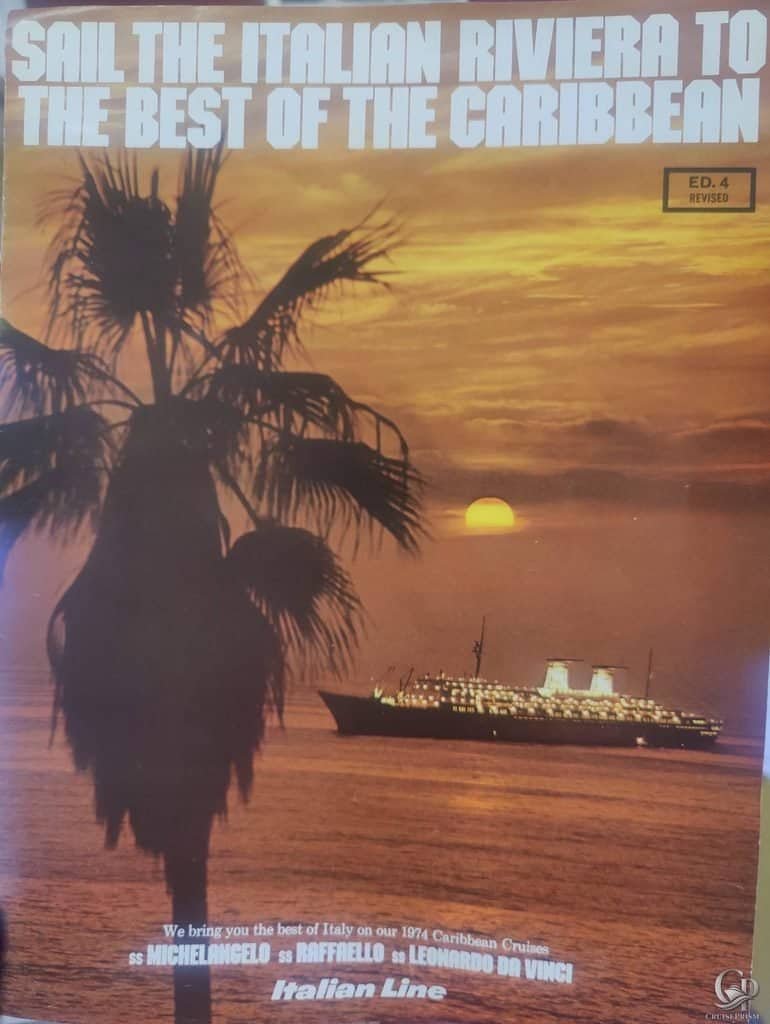
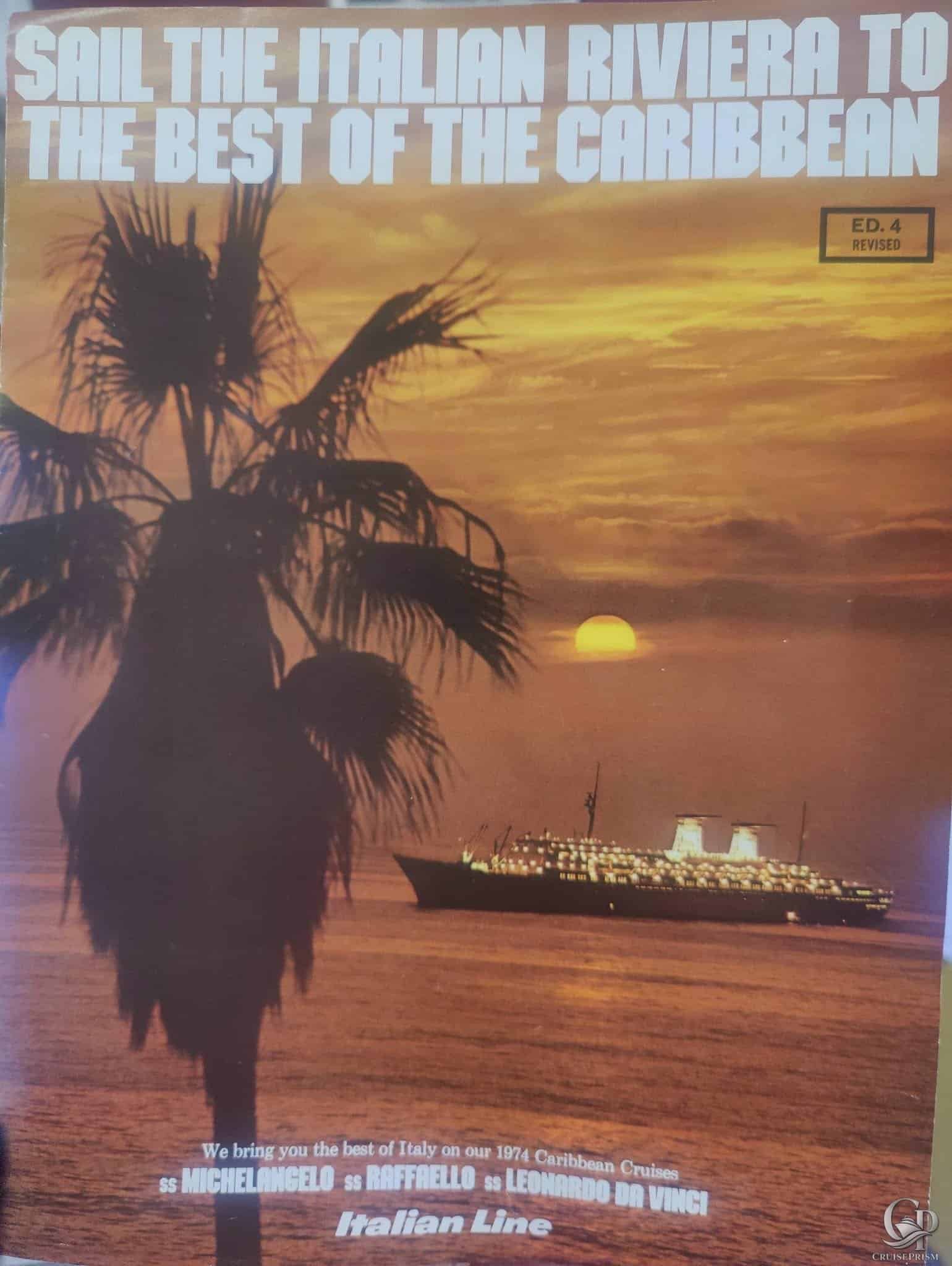
The brochure carries the promotional headline “Sail the Italian Riviera to the Best of the Caribbean” and features an illuminated ocean liner against a tropical sunset.
The cover identifies three ships participating in the company’s 1974 Caribbean cruise program:
- SS Michelangelo
- SS Raffaello
- SS Leonardo da Vinci
The brochure is marked as revised edition four, while the general information page carries a May 1974 edition reference.
Rather than presenting the Italian Riviera as a geographical destination for these Caribbean sailings, Italian Line used the concept to promote an Italian lifestyle at sea, combining European hospitality, cuisine, entertainment and tropical destinations.
The three featured ships were originally designed as ocean liners, making this brochure particularly interesting from a historical perspective.
The History of Italian Line
Italian Line, formally known as Italia Società di Navigazione, was one of Italy’s most prominent passenger shipping companies.
Established in 1932 through the consolidation of major Italian shipping companies, Italian Line became internationally associated with transatlantic passenger transportation between Europe and the Americas.
Among its best-known ocean liners were:
- SS Rex
- SS Conte di Savoia
- SS Andrea Doria
- SS Cristoforo Colombo
- SS Leonardo da Vinci
- SS Michelangelo
- SS Raffaello
During the second half of the twentieth century, the rapid expansion of commercial aviation significantly reduced demand for traditional transatlantic ocean crossings.
Italian Line increasingly marketed its passenger ships for leisure cruises, allowing travelers to experience Italian hospitality while visiting Mediterranean and Caribbean destinations.
The photographed 1974 brochure represents the final years of Italian Line’s traditional passenger operations. Within a relatively short period, all three ships advertised in the brochure would leave the company’s passenger fleet.
The Three Italian Line Ocean Liners Featured in 1974
SS Michelangelo
SS Michelangelo entered service in 1965 and was one of the last major Italian ocean liners constructed specifically for transatlantic passenger service.
Her approximate specifications included:
- Entered service: 1965
- Gross tonnage: 45,900 gross tons
- Length: 276 meters or 905 feet
- Service speed: 26.5 knots
- Original passenger capacity: approximately 1,775
- Sister ship: SS Raffaello
- Propulsion: Steam turbines
Michelangelo was distinguished by her unusual open-framework funnels, modern exterior design and interiors reflecting contemporary Italian artistic and architectural styles.
The photographed brochure includes several Caribbean sailings aboard Michelangelo, including a Thanksgiving cruise departing New York in November 1974.
SS Raffaello
SS Raffaello was Michelangelo’s sister ship and also entered service in 1965.
Although the two vessels shared similar machinery and exterior designs, their interior decorations and furnishings were individually developed.
Her approximate specifications included:
- Entered service: 1965
- Gross tonnage: 45,900 gross tons
- Length: 276 meters or 906 feet
- Service speed: 26.5 knots
- Original passenger capacity: approximately 1,775
- Sister ship: SS Michelangelo
- Propulsion: Steam turbines
Raffaello appears extensively throughout the photographed 1974 Caribbean sailing schedule, including voyages visiting Puerto Rico, the United States Virgin Islands, Martinique, Curaçao and St. Maarten.
SS Leonardo da Vinci
SS Leonardo da Vinci entered service in 1960, five years before Michelangelo and Raffaello.
The ship was constructed as a replacement for SS Andrea Doria, which sank in 1956 following a collision with the Swedish passenger liner Stockholm.
Her approximate specifications included:
- Entered service: 1960
- Gross tonnage: 33,340 gross tons
- Length: 232 meters or 761 feet
- Service speed: 23 knots
- Original passenger capacity: approximately 1,326
- Propulsion: Steam turbines
Leonardo da Vinci became increasingly involved in leisure cruising as demand for transatlantic passenger transportation declined.
The photographed brochure includes Caribbean sailings aboard Leonardo da Vinci ranging from seven-day voyages to a 13-day Christmas and New Year cruise.
Caribbean Cruise Destinations in 1974
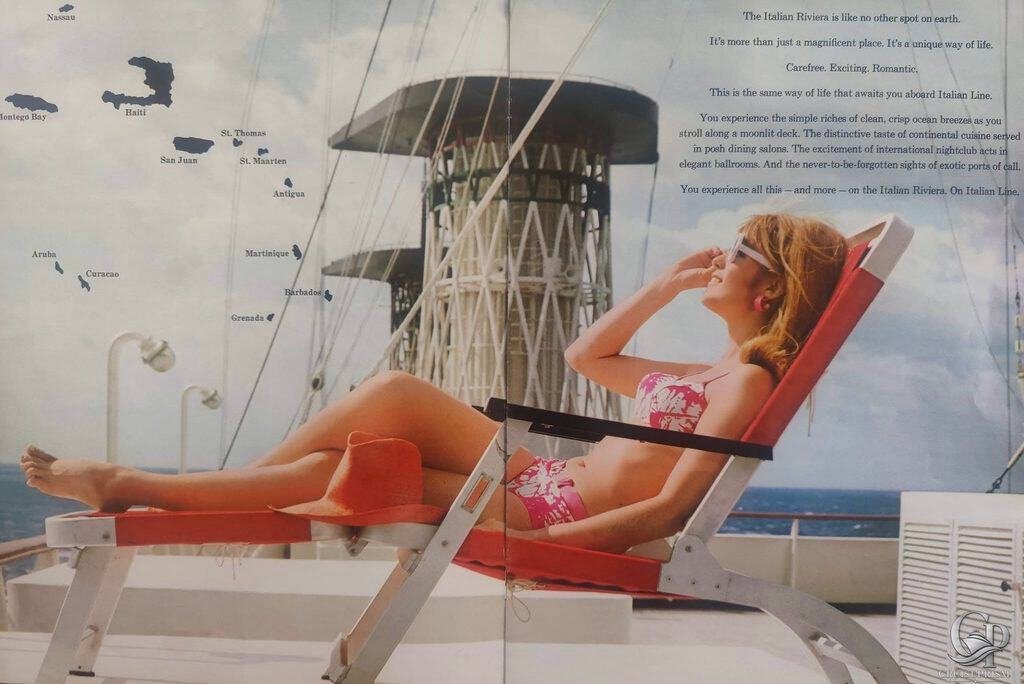
The brochure combines tropical destinations with photographs of passengers enjoying traditional ocean liner sun decks.
Several destinations identified in the promotional material remain popular Caribbean cruise ports today.
Destinations shown on the illustrated Caribbean map include:
- Nassau, Bahamas
- Montego Bay, Jamaica
- Haiti
- San Juan, Puerto Rico
- St. Thomas, United States Virgin Islands
- St. Maarten
- Antigua
- Martinique
- Barbados
- Grenada
- Aruba
- Curaçao
The detailed sailing schedules also identify Freeport in the Bahamas and La Guaira in Venezuela.
Many of these destinations continue to feature prominently in modern Eastern, Western and Southern Caribbean cruise itineraries.
However, the brochure also illustrates how Caribbean cruise routes have changed over the decades. La Guaira, for example, appeared on the advertised 1974 Christmas voyage, while Venezuela is considerably less common on contemporary mainstream Caribbean cruise itineraries.
The destinations featured on the promotional map should not be interpreted as ports visited on every sailing. Each voyage had its own published itinerary.
What Was Life Like Aboard an Italian Line Cruise in 1974?
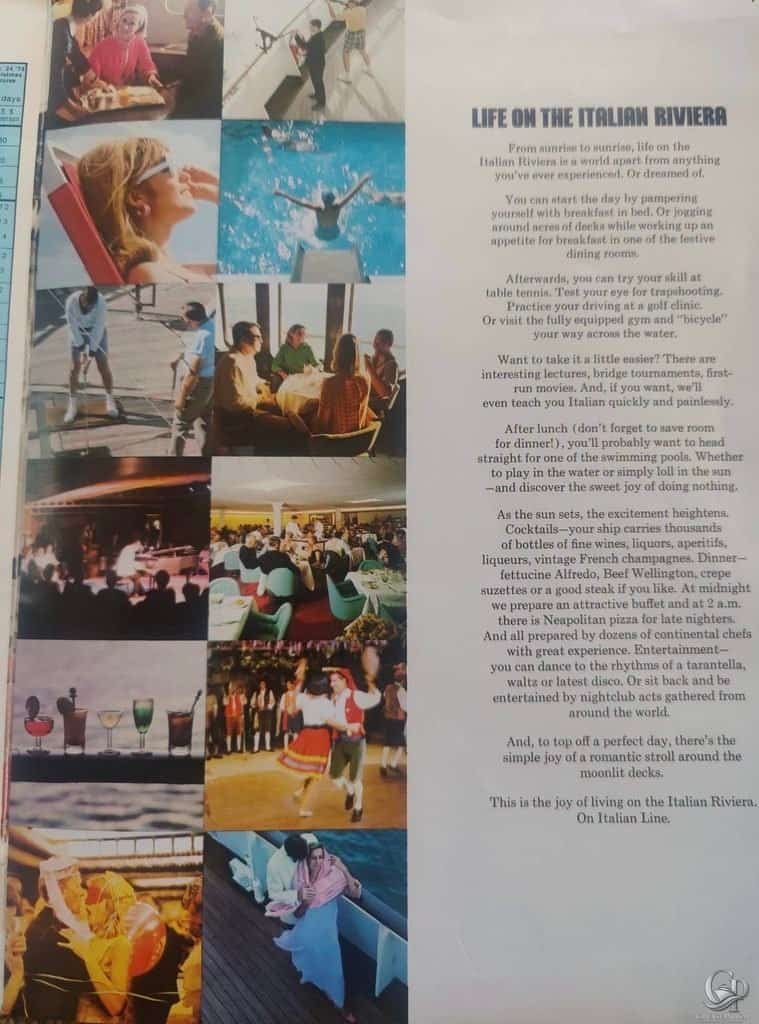
One of the most interesting pages of the historic brochure describes an entire day aboard an Italian Line Caribbean cruise, beginning with breakfast and continuing until late-night entertainment.
Although the ships were constructed as ocean liners, the advertised onboard experience included many activities that remain familiar to modern cruise passengers.
Morning Activities
Passengers could begin their day with breakfast in their cabin or visit one of the ship’s dining rooms.
The brochure promoted a range of morning activities, including:
- Jogging around the outdoor decks
- Table tennis
- Trapshooting
- Golf instruction
- Exercise in the gymnasium
- Stationary cycling
- Lectures
- Bridge tournaments
- Movie screenings
- Italian language lessons
The inclusion of trapshooting is particularly notable. It reflects a period when certain recreational activities aboard passenger ships differed considerably from those offered on contemporary mainstream cruise vessels.
Passengers interested in a quieter experience could attend lectures, watch movies or participate in card games.
Afternoon Activities and Swimming Pools
Afternoons were promoted as opportunities to enjoy lunch, relax beside the swimming pools and spend time on the open decks.
The brochure photographs show passengers swimming, sunbathing, participating in recreational activities and enjoying drinks together.
Rather than emphasizing large-scale attractions, the promotional material focused heavily on relaxation, social interaction and traditional shipboard leisure.
Evening Entertainment
Evening activities combined dining, cocktails, dancing and international entertainment.
The advertised entertainment included:
- International nightclub performers
- Ballroom dancing
- Waltzes
- Disco music
- Traditional Italian tarantella dancing
- Evening cocktails
- Moonlit walks around the outdoor decks
The combination of traditional ballroom entertainment and contemporary disco music provides an interesting reflection of the cultural changes taking place during the 1970s.
Dining Aboard Italian Line Caribbean Cruises
Food was a major component of Italian Line’s cruise marketing.
The 1974 brochure emphasized continental cuisine, elegant dining rooms and meals prepared by experienced chefs.
Examples of dishes mentioned in the promotional material include:
- Fettuccine Alfredo
- Beef Wellington
- Crêpes Suzette
- Steak
- Neapolitan pizza
These were examples of the advertised culinary experience rather than a complete restaurant menu.
Passengers could also enjoy breakfast in their cabin, traditional dining room meals and an extensive selection of alcoholic beverages.
The brochure promoted wines, liquors, aperitifs, liqueurs and vintage French Champagne, although beverages were generally excluded from the standard cruise fare.
Midnight Buffets and Pizza at 2:00 A.M.
One of the most nostalgic details in the brochure is its late-night dining schedule.
Italian Line advertised a buffet at midnight, followed by Neapolitan pizza at 2:00 a.m.
The traditional midnight buffet was once a recognizable feature of ocean liner and cruise ship dining.
While many modern cruise lines continue to offer late-night pizza and snacks, elaborate nightly midnight buffets have become less common.
The 1974 brochure demonstrates that late-night dining was already an important part of the leisure cruise experience more than half a century ago.
Italian Line Cruise Policies and General Information in 1974
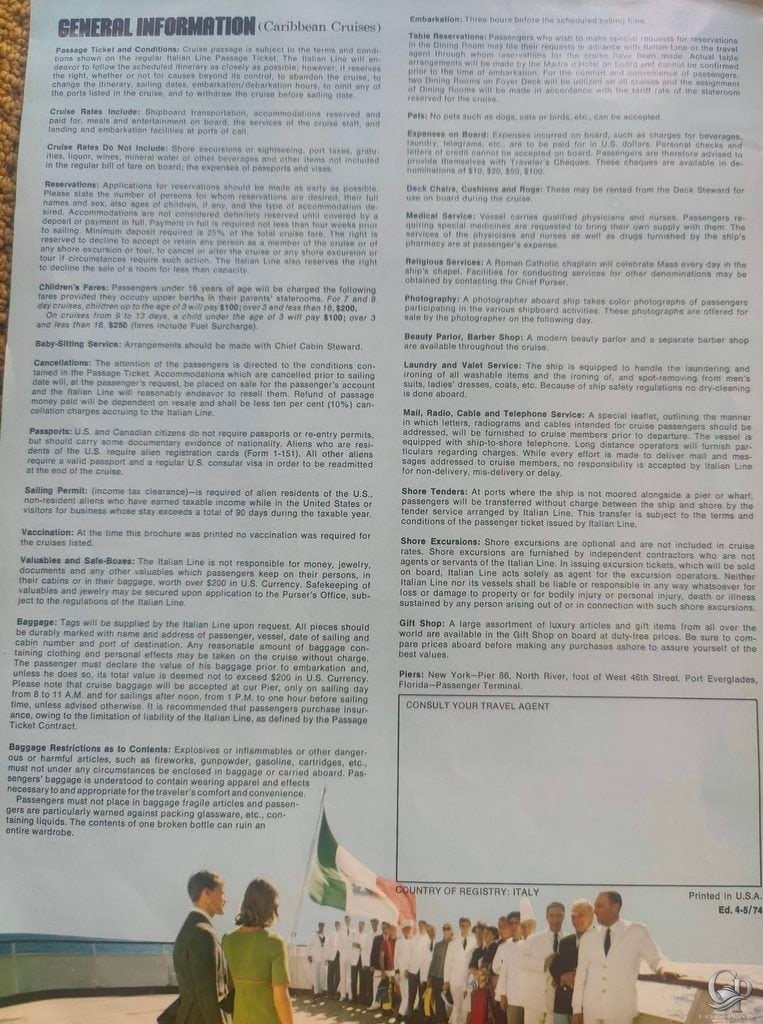
The general information page offers a valuable insight into the practical aspects of booking and taking a Caribbean cruise in 1974.
Many policies resemble those used by cruise lines today, while others illustrate how passenger travel has evolved.
What Was Included in the Cruise Fare?
According to the brochure, standard cruise rates included:
- Transportation aboard the ship
- Reserved passenger accommodations
- Onboard meals
- Onboard entertainment
- Services provided by the cruise staff
- Landing and embarkation facilities at ports of call
This structure resembles the traditional cruise fare model still used by many mainstream cruise lines.
What Was Not Included in the Cruise Fare?
Passengers were expected to pay separately for several additional services and expenses.
These included:
- Shore excursions
- Sightseeing tours
- Port taxes
- Gratuities
- Liquor
- Wine
- Mineral water
- Other beverages
- Items not included in the regular onboard dining selection
- Passport and visa expenses
The exclusion of shore excursions, alcoholic beverages and gratuities demonstrates that additional onboard expenses were already an established part of the cruise industry in 1974.
Reservations and Cruise Deposits
Italian Line required passengers to provide personal information when making a cruise reservation, including the names of travelers, children’s ages and the desired accommodation category.
The brochure specified the following payment conditions:
- Minimum deposit: 25% of the total cruise fare
- Final payment: At least four weeks before sailing
Accommodation reservations were not considered definite until a deposit or full payment had been received.
The company’s cancellation policy stated that canceled accommodations could be offered for resale on behalf of the passenger.
Refunds depended on successful resale, with a 10% cancellation charge deducted under the conditions described in the brochure.
These were historical Italian Line booking conditions and should not be confused with current cruise industry cancellation policies.
How Much Did Children Pay for an Italian Line Cruise in 1974?
The brochure included special fares for passengers under 16 years of age occupying upper berths in their parents’ staterooms.
For seven- and eight-day cruises:
- Children up to three years old: $100.00
- Children over three and under 16 years old: $200.00
For cruises lasting nine to 13 days:
- Children under three years old: $100.00
- Children over three and under 16 years old: $250.00
These advertised children’s fares included the fuel surcharge.
Babysitting services could also be arranged through the Chief Cabin Steward.
The brochure does not provide babysitting prices or further information about organized children’s entertainment.
Onboard Services and Facilities
Italian Line advertised a range of practical services for passengers traveling aboard its ocean liners.
Medical Services
The ships carried physicians and nurses, and passengers were advised to bring any necessary specialized medication.
Medical consultations, nursing services and medications provided by the ship’s pharmacy were charged separately.
Beauty Parlors and Barber Shops
Passengers had access to onboard beauty parlors and separate barber shops.
Laundry, ironing and certain garment-cleaning services were also available.
The brochure specifically stated that dry-cleaning services were not performed onboard because of ship safety regulations.
Religious Services
A Roman Catholic chaplain celebrated daily Mass in the ship’s chapel.
Arrangements for services of other religious denominations could be requested through the Chief Purser.
Onboard Photography
Ship photographers took color photographs of passengers participating in onboard activities.
These photographs were offered for purchase the following day.
This service closely resembles the professional photography arrangements still offered aboard many contemporary cruise ships.
Duty-Free Shopping
The onboard gift shop offered luxury goods and gifts from different parts of the world at advertised duty-free prices.
Passengers were encouraged to compare onboard prices with those available ashore before purchasing merchandise.
Communication at Sea Before Wi-Fi and Smartphones
The 1974 brochure provides a reminder of how different shipboard communication was before the internet and modern mobile technology.
Passengers could communicate using:
- Letters
- Radiograms
- Cable messages
- Ship-to-shore telephone services
Long-distance telephone charges could be obtained from the appropriate onboard operators.
Passengers were also provided with instructions explaining how friends and family could address correspondence to travelers aboard the ship.
There were no internet packages, messaging applications or satellite Wi-Fi services comparable to those used aboard modern cruise ships.
Paying for Onboard Expenses in 1974
The brochure specified that onboard expenses were payable in United States dollars.
Personal checks and letters of credit were not accepted, and passengers were encouraged to carry traveler’s checks.
The denominations mentioned included:
- $10.00
- $20.00
- $50.00
- $100.00
This differs considerably from today’s cruise experience, where most passengers use electronic onboard spending accounts connected to a credit card or other payment method.
The brochure also indicated that passengers could rent deck chairs, cushions and rugs through the Deck Steward.
This is another interesting historical detail, as standard outdoor deck loungers are generally available without an additional rental charge on modern mainstream cruise ships.
SS Leonardo da Vinci Caribbean Cruise Prices in 1974
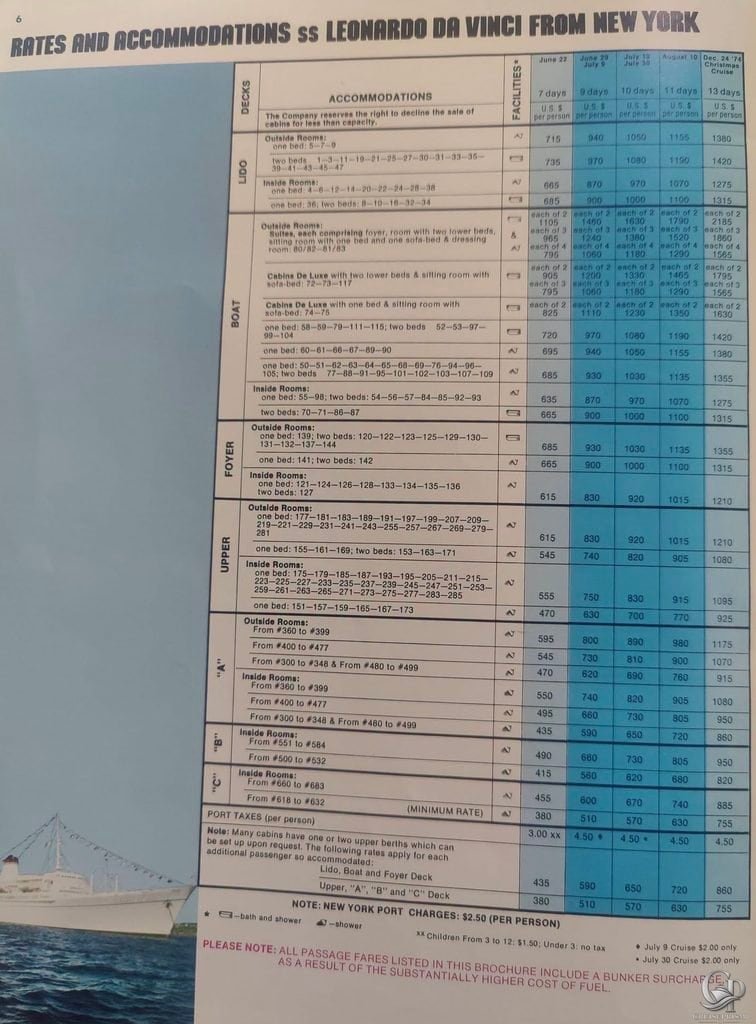
The original fare schedule for Leonardo da Vinci provides a detailed breakdown of cruise prices according to sailing length, cabin location, accommodation type and occupancy.
The advertised departures included:
- June 22, 1974 – Seven-day cruise
- June 29, 1974 – Nine-day cruise
- July 9, 1974 – Nine-day cruise
- July 19, 1974 – Ten-day cruise
- July 30, 1974 – Ten-day cruise
- August 10, 1974 – Eleven-day cruise
- December 24, 1974 – Thirteen-day Christmas cruise
All listed fares were in United States dollars and generally quoted per person.
Minimum Cruise Fares Aboard Leonardo da Vinci
The lowest advertised accommodation prices were:
- Seven-day cruise – $380.00 per person
- Nine-day cruise – $510.00 per person
- Ten-day cruise – $570.00 per person
- Eleven-day cruise – $630.00 per person
- Thirteen-day Christmas cruise – $755.00 per person
These minimum rates applied to designated inside accommodations on C Deck.
Port taxes and other applicable charges were listed separately.
Inside and Outside Cabin Prices
Leonardo da Vinci offered several accommodation categories distributed across Lido, Boat, Foyer, Upper, A, B and C decks.
Examples of advertised seven-day cruise prices included:
- C Deck minimum-rate inside room – $380.00 per person
- B Deck selected inside room – $415.00 per person
- A Deck selected inside room – $435.00 per person
- A Deck selected outside room – $470.00 per person
- Upper Deck selected outside room – $545.00 per person
- Lido Deck selected inside room – $665.00 per person
- Lido Deck selected outside room – $715.00 per person
- Lido Deck selected two-bed outside room – $735.00 per person
The fare schedule distinguished accommodations by their bathroom facilities, including rooms equipped with showers and those offering both a bath and shower.
Deluxe Cabins and Suites
Passengers seeking more spacious accommodations could reserve deluxe cabins and suites on Boat Deck.
The brochure describes suites featuring:
- An entrance foyer
- A bedroom with lower beds
- A separate sitting room
- Additional sleeping arrangements
- A dressing room
For the seven-day sailing, selected suite accommodations were advertised at $1,105.00 per person when occupied by two passengers.
The corresponding 13-day Christmas cruise fare reached $2,185.00 per person for two-person occupancy in the same suite category.
Prices per passenger decreased when certain suites accommodated three or four guests.
The distinction between inside rooms, outside rooms, deluxe cabins and suites demonstrates that accommodation-based pricing was already well established in the cruise industry.
Italian Line Caribbean Cruise Itineraries from New York
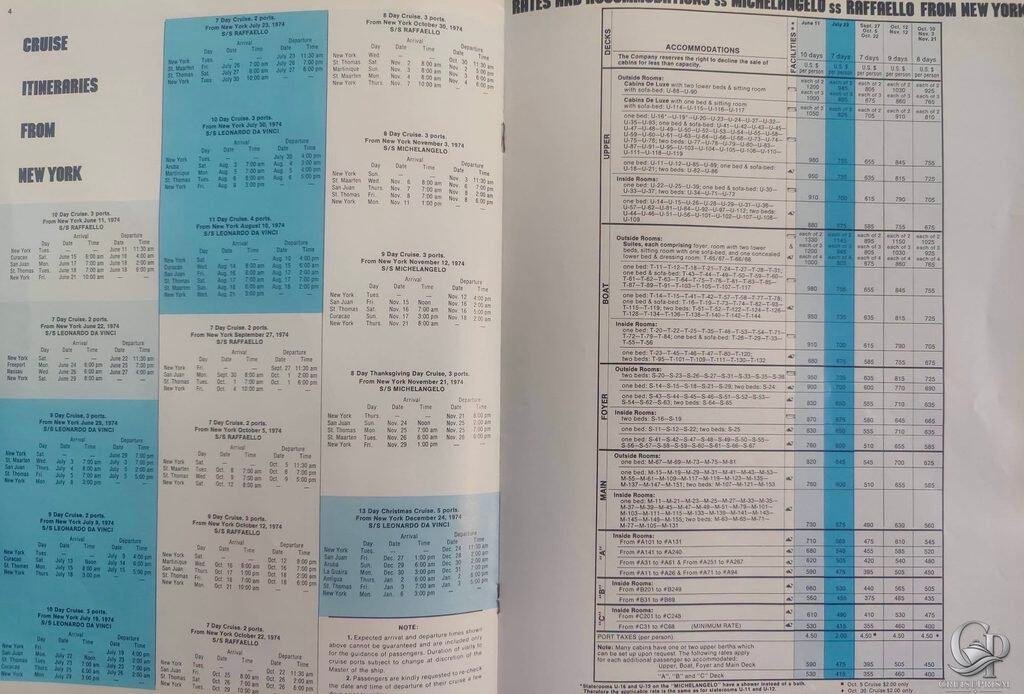
The photographed itinerary schedule includes Caribbean voyages aboard all three featured ships.
New York served as a departure and return port for the sailings shown, with itineraries ranging from seven to 13 days.
June 11, 1974 – SS Raffaello
Ten-day Caribbean cruise visiting three ports:
- Curaçao
- San Juan
- St. Thomas
The ship was scheduled to return to New York on June 21, 1974.
June 22, 1974 – SS Leonardo da Vinci
Seven-day Bahamas cruise visiting two ports:
- Freeport
- Nassau
The ship was scheduled to return to New York on June 29, 1974.
June 29, 1974 – SS Leonardo da Vinci
Nine-day Caribbean cruise visiting three ports:
- St. Maarten
- San Juan
- St. Thomas
The ship was scheduled to return to New York on July 8, 1974.
July 9, 1974 – SS Leonardo da Vinci
Nine-day Caribbean cruise visiting two ports:
- Curaçao
- St. Thomas
The ship was scheduled to return to New York on July 18, 1974.
July 19, 1974 – SS Leonardo da Vinci
Ten-day Caribbean cruise visiting three ports:
- San Juan
- St. Thomas
- Curaçao
The ship was scheduled to return to New York on July 29, 1974.
July 23, 1974 – SS Raffaello
Seven-day Caribbean cruise visiting two ports:
- St. Maarten
- St. Thomas
The ship was scheduled to return to New York on July 30, 1974.
July 30, 1974 – SS Leonardo da Vinci
Ten-day Southern and Eastern Caribbean cruise visiting three ports:
- Aruba
- Martinique
- St. Thomas
The ship was scheduled to return to New York on August 9, 1974.
August 10, 1974 – SS Leonardo da Vinci
Eleven-day Caribbean cruise visiting four ports:
- Curaçao
- San Juan
- St. Thomas
- St. Maarten
The ship was scheduled to return to New York on August 21, 1974.
September 27, 1974 – SS Raffaello
Seven-day Caribbean cruise visiting two ports:
- San Juan
- St. Thomas
The ship was scheduled to return to New York on October 4, 1974.
October 5, 1974 – SS Raffaello
Seven-day Caribbean cruise visiting two ports:
- St. Maarten
- St. Thomas
The ship was scheduled to return to New York on October 12, 1974.
October 12, 1974 – SS Raffaello
Nine-day Caribbean cruise visiting three ports:
- Martinique
- San Juan
- St. Thomas
The ship was scheduled to return to New York on October 21, 1974.
October 22, 1974 – SS Raffaello
Seven-day Caribbean cruise visiting two ports:
- San Juan
- St. Thomas
The ship was scheduled to return to New York on October 29, 1974.
October 30, 1974 – SS Raffaello
Eight-day Caribbean cruise visiting three ports:
- St. Thomas
- Martinique
- St. Maarten
The ship was scheduled to return to New York on November 7, 1974.
November 3, 1974 – SS Michelangelo
Eight-day Caribbean cruise visiting three ports:
- St. Maarten
- San Juan
- St. Thomas
The ship was scheduled to return to New York on November 11, 1974.
November 12, 1974 – SS Michelangelo
Nine-day Caribbean cruise visiting three ports:
- San Juan
- St. Thomas
- Curaçao
The ship was scheduled to return to New York on November 21, 1974.
Italian Line Thanksgiving Cruise in 1974
SS Michelangelo was scheduled to depart New York on November 21, 1974, for an eight-day Thanksgiving Caribbean cruise.
The advertised itinerary included:
- November 21 – Depart New York
- November 24 – San Juan, Puerto Rico
- November 25 – St. Thomas, United States Virgin Islands
- November 26 – St. Maarten
- November 29 – Return to New York
The voyage was scheduled to spend Thanksgiving Day at sea while returning to New York.
The brochure does not provide a Thanksgiving dinner menu or details of special celebrations.
Nevertheless, the itinerary demonstrates that holiday-themed Caribbean cruises were already being marketed more than half a century ago.
Italian Line Christmas and New Year Cruise in 1974
One of the longest voyages shown in the photographed sailing schedule was the 13-day Christmas cruise aboard Leonardo da Vinci.
The ship was scheduled to depart New York on December 24, 1974, and return on January 6, 1975.
The advertised itinerary included:
- December 24 – Depart New York
- December 27 – San Juan, Puerto Rico
- December 29 – Aruba
- December 30–31 – La Guaira, Venezuela
- January 2 – Antigua
- January 3 – St. Thomas
- January 6 – Return to New York
A particularly interesting feature was the extended visit to La Guaira, with arrival scheduled for 3:00 p.m. on December 30 and departure at 7:00 p.m. on December 31.
The voyage therefore offered passengers the opportunity to spend part of New Year’s Eve in Venezuela before returning to sea.
Minimum advertised fares for this Christmas cruise started at $755.00 per person, while selected suite accommodations cost as much as $2,185.00 per person based on double occupancy.
As with the other itineraries, the brochure stated that advertised arrival and departure times were subject to change.
SS Michelangelo and SS Raffaello Cruise Prices in 1974
The historic fare schedule includes separate accommodation prices for Michelangelo and Raffaello.
Both ships offered accommodations across Upper, Boat, Foyer, Main, A, B and C decks.
The minimum advertised cruise fares included:
- June 11 ten-day cruise – $530.00 per person
- July 23 seven-day cruise – $415.00 per person
- September 27, October 5 and October 22 seven-day cruises – $355.00 per person
- October 12 and November 12 nine-day cruises – $460.00 per person
- October 30, November 3 and November 21 eight-day cruises – $400.00 per person
The lowest advertised fare across the photographed accommodation schedules was therefore $355.00 per person for selected seven-day sailings aboard Raffaello.
For two passengers occupying qualifying accommodation, that represented a combined base cruise fare of $710.00 before separately listed taxes and additional expenses.
Higher accommodation categories commanded considerably larger fares.
For example, selected Boat Deck suites were advertised at $1,390.00 per person for the June 11 ten-day cruise when occupied by two passengers.
The same suite category was advertised at $895.00 per person for selected seven-day autumn sailings.
The difference illustrates how seasonal demand, voyage duration and accommodation category influenced cruise pricing even in 1974.
Port Taxes, Fuel Surcharges and Additional Cruise Charges
The photographed rate schedules provide an interesting look at how cruise charges were presented during the 1970s.
Port taxes varied according to the sailing, generally ranging from $2.00 to $4.50 per person across the photographed fare schedules.
The Leonardo da Vinci rate schedule also specifies a separate New York port charge of $2.50 per person.
Importantly, the brochure states that advertised passage fares already included a bunker surcharge resulting from substantially increased fuel costs.
A bunker surcharge is an additional amount associated with the cost of marine fuel.
This detail is historically significant because the brochure was published shortly after the 1973 oil crisis, which dramatically increased operating expenses for many passenger shipping companies.
Large, high-speed steam-powered ocean liners were particularly vulnerable to increasing fuel costs.
The inclusion of the surcharge in the advertised rates provides direct evidence of how international economic conditions affected cruise pricing in 1974.
Were Caribbean Cruises Really Cheaper in 1974?
At first glance, a seven-day Caribbean cruise starting at $355.00 per person appears remarkably inexpensive.
However, these figures are historical prices expressed in 1974 United States dollars.
Inflation, changes in household income, ship operating expenses and the expansion of the modern cruise industry make direct comparisons with contemporary cruise prices misleading.
The advertised starting fares also applied to specified inside accommodations, while more desirable outside rooms and suites could cost substantially more.
Passengers additionally paid for expenses such as:
- Gratuities
- Port taxes
- Beverages
- Shore excursions
- Certain onboard services
One of the most interesting aspects of the brochure is how familiar its pricing model remains today. Cruise fares varied according to cabin category, sailing duration, departure date and occupancy, much as they do in the contemporary cruise industry.
Where Did Italian Line Caribbean Cruises Depart From?
The general information page identifies two United States embarkation facilities:
- New York – Pier 86, North River, at the foot of West 46th Street
- Port Everglades, Florida – Passenger Terminal
The detailed itineraries and accommodation schedules photographed for this article specifically cover New York departures.
Although Port Everglades is identified as an embarkation facility, the photographed materials do not establish the detailed Florida departure itineraries or fares.
Both New York and Port Everglades remain important departure locations within the contemporary cruise industry.
What Happened to the Three Italian Line Ocean Liners?
The publication of the 1974 brochure came near the end of a remarkable era in Italian passenger shipping.
The historical records maintained by the Italian Liners Historical Society document how increasing competition from commercial aviation and the economic consequences of the 1973 oil crisis contributed to the decline of Italian Line’s passenger operations.
What Happened to SS Michelangelo?
Michelangelo was withdrawn from Italian Line service in 1975, approximately ten years after entering service.
She was subsequently sold to Iran and used as accommodation for military personnel.
The vessel was eventually sold for dismantling in the early 1990s.
What Happened to SS Raffaello?
Raffaello was also withdrawn from Italian Line service in 1975.
Like Michelangelo, she was sold to Iran for use as a floating accommodation facility.
The ship was severely damaged during the Iran–Iraq War in 1983 and never returned to passenger service.
What Happened to SS Leonardo da Vinci?
Leonardo da Vinci continued operating longer than the two newer sister ships.
Her final Caribbean cruise from New York under Italian Line took place in 1977.
She subsequently operated as a cruise ship under Italia Crociere Internazionali before being withdrawn from service in 1978.
In 1980, the laid-up vessel suffered a major fire and capsized. She was subsequently dismantled.
None of the three ocean liners featured in the historic brochure survives as an operational passenger ship.
How Cruising in 1974 Compares With Modern Caribbean Cruises
The Italian Line brochure demonstrates that many aspects of contemporary cruising were already established by 1974.
Features that remain familiar include:
- Multiple dining venues
- Swimming pools
- Onboard gyms
- Professional entertainment
- Specialty beverages
- Duty-free shopping
- Professional photography
- Organized shore excursions
- Different accommodation categories
- Family cruise fares
- Holiday-themed sailings
- Additional onboard expenses
Other features reflect a different period in passenger travel:
- Traveler’s checks instead of electronic onboard accounts
- Radiograms and ship-to-shore telephones instead of internet packages
- Deck chair rental
- Onboard trapshooting
- Italian language lessons
- Traditional midnight buffets
- Extensive ballroom dancing
- Longer port visits on selected itineraries
Modern cruise ships have introduced attractions, technologies and entertainment facilities that were not part of the photographed Italian Line experience.
However, the fundamental appeal of visiting multiple destinations while enjoying dining, entertainment and relaxation at sea remains remarkably similar.
Frequently Asked Questions
What was Italian Line?
Italian Line was a major Italian passenger shipping company historically associated with transatlantic ocean crossings and leisure cruises. Its fleet included some of Italy’s best-known twentieth-century ocean liners.
Which Italian Line ships operated Caribbean cruises in 1974?
The photographed brochure features SS Michelangelo, SS Raffaello and SS Leonardo da Vinci.
How much did a Caribbean cruise cost in 1974?
The lowest fare shown in the photographed Italian Line brochure was $355.00 per person for selected seven-day Caribbean sailings aboard Raffaello. Accommodation upgrades, additional charges and longer itineraries increased the total cost.
How much did a seven-day cruise aboard Leonardo da Vinci cost?
The minimum advertised fare for the June 22, 1974, seven-day Bahamas cruise was $380.00 per person.
Were meals included on Italian Line cruises?
Yes. The brochure specifically identifies onboard meals as part of the standard cruise fare.
Were alcoholic beverages included?
No. The general information page lists liquor, wine, mineral water and other beverages among the expenses excluded from standard cruise rates.
Did Italian Line offer holiday cruises?
Yes. The photographed brochure includes an eight-day Thanksgiving cruise aboard Michelangelo and a 13-day Christmas and New Year cruise aboard Leonardo da Vinci.
Did cruise ships have midnight buffets in 1974?
Yes. Italian Line specifically advertised midnight buffets and Neapolitan pizza served at 2:00 a.m.
Could passengers participate in trapshooting onboard?
Yes. Trapshooting was among the recreational activities advertised in the photographed 1974 brochure.
Were shore excursions included in Italian Line cruise fares?
No. Shore excursions were optional and charged separately.
Did Italian Line sail to Venezuela?
Yes. The advertised December 24, 1974, Christmas cruise aboard Leonardo da Vinci included an extended visit to La Guaira, Venezuela.
Did Italian Line operate from Florida?
Yes. Port Everglades, Florida, is identified as an embarkation facility in the brochure. The detailed photographed sailing schedules, however, cover departures from New York.
Why did Italian Line stop operating passenger ships?
Competition from commercial aviation, declining demand for transatlantic ocean travel, high operating expenses and rising fuel costs contributed to the decline of Italian Line’s traditional passenger operations during the 1970s.
Are Michelangelo, Raffaello and Leonardo da Vinci still sailing?
No. All three vessels were permanently withdrawn from passenger service decades ago.
Is this brochure evidence that every advertised cruise operated as scheduled?
No. The brochure documents the itineraries, fares and experiences advertised by Italian Line in 1974. It does not independently confirm that every scheduled voyage operated exactly as published.
Final Thoughts
This original 1974 Italian Line Caribbean cruise brochure offers an extraordinary glimpse into a transitional period in maritime history.
Traditional ocean liners were increasingly being marketed as vacation destinations, combining their established reputations for elegant dining and European hospitality with tropical ports, swimming pools, recreational activities and international entertainment.
The advertised $355.00 starting fares, midnight buffets, Italian language lessons, extended Caribbean port visits and traditional onboard services reveal both the similarities and differences between cruising in 1974 and cruising today.
The brochure is particularly significant because it features Michelangelo, Raffaello and Leonardo da Vinci shortly before the end of their Italian Line careers.
Although these three ocean liners have disappeared, historical brochures such as this one preserve valuable details about their passenger experiences, original cruise prices, sailing schedules and onboard traditions.
For maritime history enthusiasts, ocean liner collectors and modern cruise travelers, this historic promotional material serves as a fascinating reminder of how Caribbean cruising evolved into the global vacation industry we know today.