RMS Titanic’s 1911 Launch: Rare Original Photographs and Newspaper Report
On May 31, 1911, the RMS Titanic entered the water for the first time at the Harland and Wolff shipyard in Belfast, Northern Ireland. The enormous White Star Line ocean liner was still unfinished, but her launch marked one of the most remarkable achievements in early twentieth-century shipbuilding.
Today, Titanic is remembered primarily for her tragic sinking in April 1912. However, the original photographs and newspaper coverage from her launch tell a very different story: one of engineering innovation, industrial ambition, and excitement about the future of transatlantic travel.
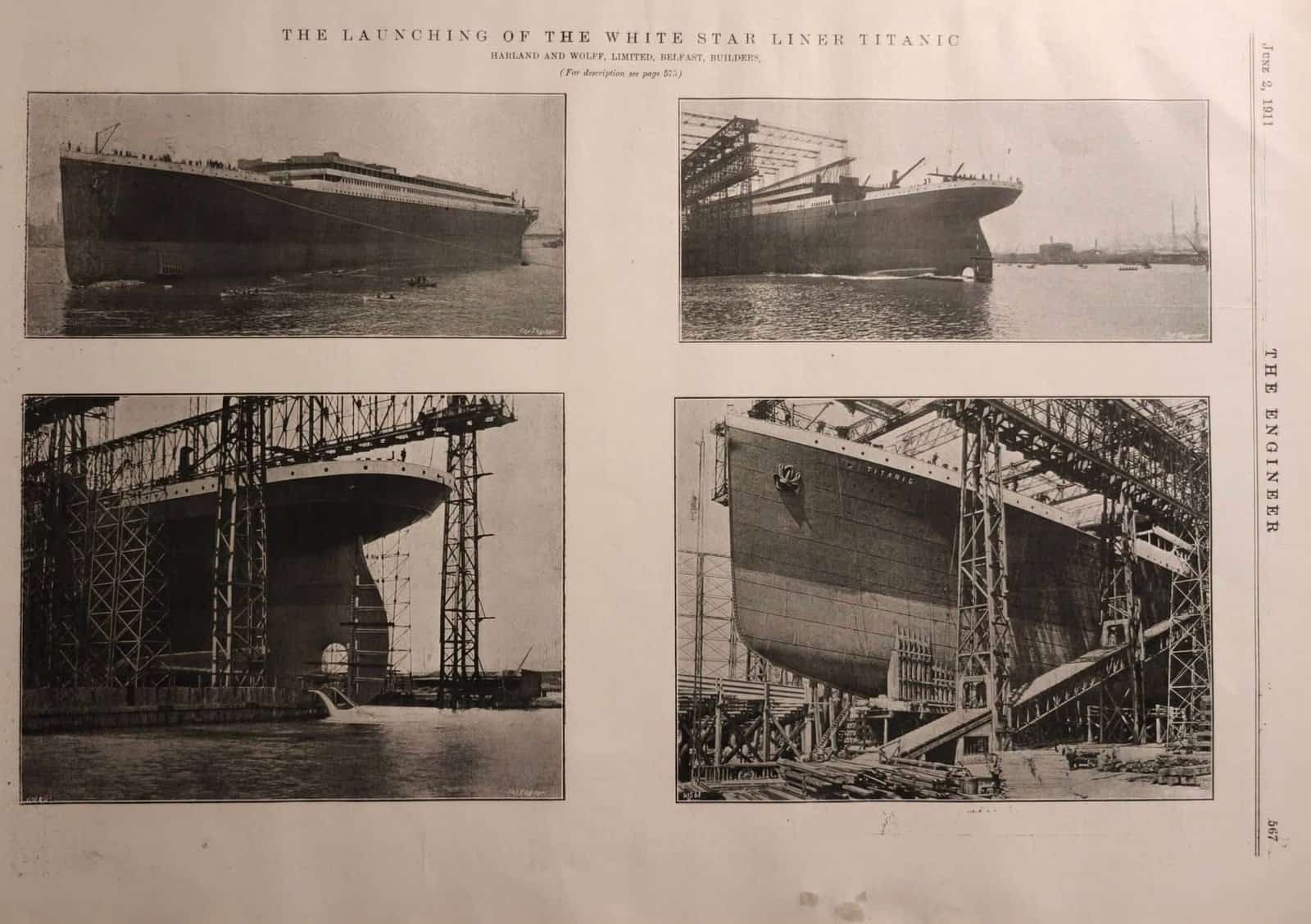
The two historical documents featured here provide an extraordinary glimpse into that moment. The first is a photographic feature published in the June 2, 1911, edition of The Engineer, showing four views of Titanic’s unfinished hull and the enormous shipyard structures surrounding her. The second is a contemporary article titled “The Launch of the Titanic,” describing the event in remarkable detail, including the launching mechanism, the vessel’s speed, and the tugboats that assisted her afterward.
Together, these documents preserve a fascinating record of Titanic before she became one of the most famous ships in history.
Rare Original Photographs of Titanic’s Launch in 1911
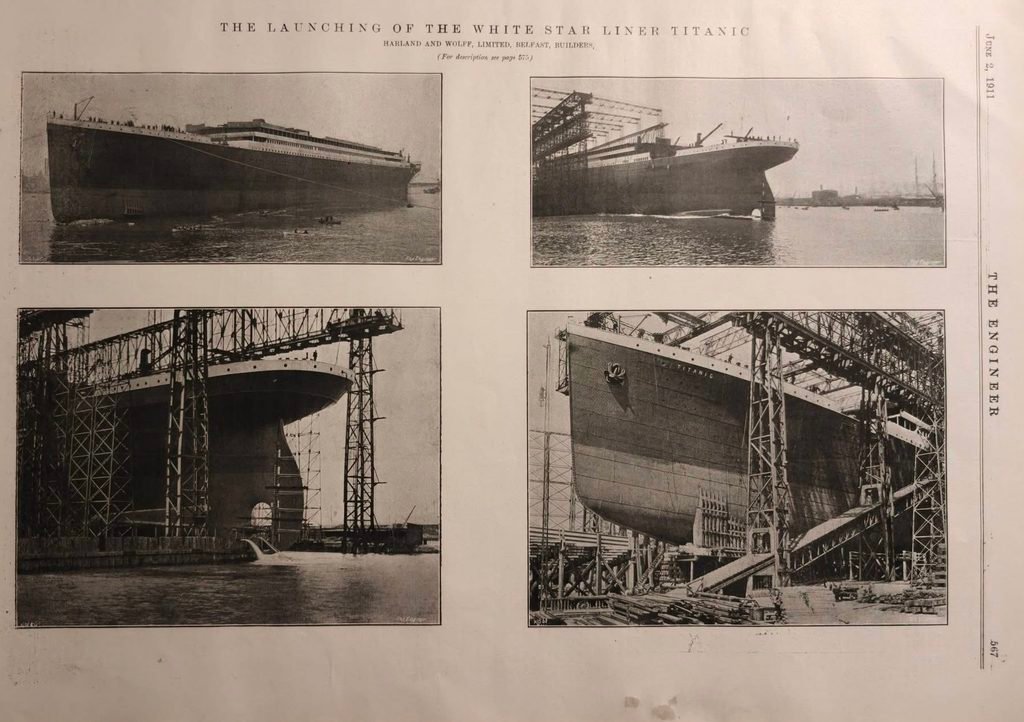
The first document is a full-page photographic feature titled “The Launching of the White Star Liner Titanic.”
Published in The Engineer on June 2, 1911, page 567, it identifies Harland and Wolff Limited of Belfast as Titanic’s builders.
The four photographs offer two different perspectives on the ship’s development.
The upper images show Titanic’s enormous hull afloat, while the lower images capture the vessel surrounded by the steel gantries and construction structures used during shipbuilding.
Several details make these photographs particularly interesting:
- Titanic’s four famous funnels had not yet been installed.
- Much of the ship’s upper structure was still incomplete.
- The immense steel hull dominates the surrounding waterfront.
- Small boats visible alongside Titanic emphasize her extraordinary size.
- The construction photographs reveal the enormous industrial infrastructure required to build the vessel.
These images show Titanic at a stage rarely depicted in popular illustrations of the ship.
Rather than the completed ocean liner with her familiar black hull, white superstructure, and four funnels, we see a massive unfinished vessel transitioning from shipyard construction to the final stages of outfitting.
How Titanic Was Built at Harland and Wolff
Titanic was constructed for the White Star Line as the second of three Olympic-class ocean liners, alongside Olympic and Britannic.
Her keel was laid on March 31, 1909, at the Harland and Wolff shipyard in Belfast.
The ship was built using a steel hull assembled with extensive riveting, supported by the enormous gantry structures visible in the photographs.
At approximately 882 feet 9 inches long and 92 feet 6 inches wide, Titanic was an exceptionally large vessel for her era.
The lower photographs in The Engineer reveal how much infrastructure was needed to construct a ship of this size.
Steel frameworks tower above the hull, while platforms, supports, and other equipment surround the vessel.
One particularly impressive photograph shows Titanic’s bow from below, with the ship’s name visible near the upper edge of the hull.
The image illustrates the tremendous height of the vessel and the scale of the construction operation.
Unlike modern cruise ships, which are commonly assembled from large prefabricated blocks, Titanic was built using the shipbuilding methods and industrial technology available in the early 1900s.
The photographs provide a valuable reminder of the engineering challenges involved in constructing such an enormous ocean liner more than a century ago.
Titanic’s Launch Took Only 62 Seconds
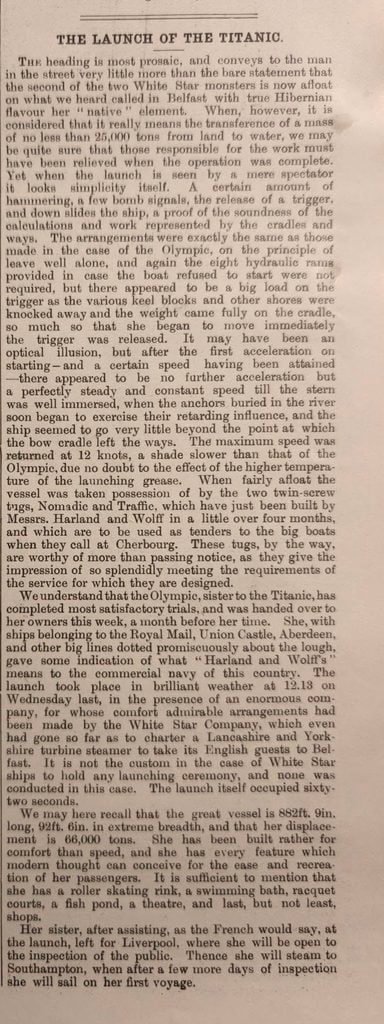
Perhaps the most remarkable detail in the second historical document is how quickly Titanic entered the water.
According to the original newspaper account, the launch itself lasted just 62 seconds.
That is an extraordinary figure considering the size and weight of the unfinished vessel.
The newspaper describes the operation as a carefully coordinated process involving the release of the launching mechanism, the removal of supporting blocks, and the movement of Titanic down the inclined launching ways.
The article explains that Titanic began moving immediately once the trigger was released.
Eight hydraulic rams had been provided in case the vessel failed to move, but they were not needed.
The newspaper also describes how the ship initially accelerated before appearing to maintain a relatively steady speed as she entered the water.
The process was controlled by gravity, rather than by Titanic’s own engines.
How Fast Was Titanic Moving During the Launch?
The contemporary article reports a maximum launching speed of 12 knots, equivalent to approximately 13.8 miles per hour.
For an unfinished ocean liner weighing tens of thousands of tons, that was an impressive speed.
The newspaper also notes that Titanic’s maximum launching speed was slightly lower than that of her sister ship Olympic.
The writer suggested that the difference might have been caused by the higher temperature of the launching grease.
This was a contemporary explanation rather than a definitively established cause.
Once Titanic entered the water, the resistance of the water and the equipment involved in controlling her movement helped slow the vessel.
The launch was therefore a carefully planned engineering operation, not simply a ship sliding uncontrolled into a harbor.
How Titanic Was Launched Without Using Her Engines
One of the most interesting aspects of Titanic’s launch is that the ship did not require her propulsion machinery to enter the water.
Instead, the enormous hull rested on a specially prepared launching cradle and inclined slipway.
The original newspaper describes the release of the launching trigger and the removal of the supporting structures that had held the ship in place.
Once released, Titanic moved down the ways under gravity.
The newspaper specifically mentions the following elements of the operation:
- A launching cradle supporting the ship’s weight.
- Keel blocks and shores removed during preparation.
- A trigger mechanism that released the vessel.
- Eight hydraulic rams available as a precaution.
- Launching grease used to reduce friction.
- The ship’s anchors and the surrounding water helping to retard her movement.
The account emphasizes the precision required to transfer such an enormous mass from land to water.
It also provides an interesting perspective on the people responsible for the operation.
Although spectators witnessed a relatively brief event, the engineers and shipyard workers had spent considerable time preparing for those 62 seconds.
The Tugboats Nomadic and Traffic Assisted Titanic
Another fascinating detail in the original article concerns the two tugboats that took control of Titanic after she entered the water.
The newspaper identifies them as Nomadic and Traffic, describing both as twin-screw vessels.
According to the account, Harland and Wolff had built them in a little over four months.
They were intended to serve as passenger tenders at Cherbourg, France, where large White Star Line ocean liners could not dock directly alongside the passenger terminal.
The tenders transported passengers between the shore and the ocean liners.
This created an interesting connection between Titanic’s construction and her future transatlantic service.
Nomadic would later serve Titanic during her maiden voyage in April 1912.
Today, SS Nomadic survives in Belfast as an important piece of maritime heritage.
The newspaper’s mention of these vessels is particularly valuable because it records their involvement in Titanic’s history before her first voyage.
Titanic’s Size and Specifications in the Original Newspaper
The contemporary newspaper includes several measurements that demonstrate the extraordinary scale of the vessel.
According to the article, Titanic had the following characteristics:
- Length: 882 feet 9 inches.
- Extreme breadth: 92 feet 6 inches.
- Displacement: 66,000 tons, as reported by the newspaper.
- Maximum launching speed: 12 knots.
- Launch duration: 62 seconds.
- Builder: Harland and Wolff, Belfast.
- Operator: White Star Line.
The 66,000-ton displacement figure should not be confused with Titanic’s commonly cited gross registered tonnage of approximately 46,328 GRT.
Displacement and gross registered tonnage measure different things. Displacement relates to the weight of water displaced by a vessel, while gross registered tonnage was a historical measure of enclosed internal volume.
The original article’s figures are particularly interesting because they show how Titanic’s size was presented to readers in 1911.
Titanic Was Designed for Comfort Rather Than Maximum Speed
The newspaper makes another important observation about Titanic.
It describes the vessel as being built for comfort rather than speed.
This reflects White Star Line’s broader approach to the Olympic-class ships.
During the early twentieth century, major transatlantic shipping companies competed for passengers traveling between Europe and North America.
Some companies emphasized speed and the prestige associated with fast Atlantic crossings.
White Star Line placed considerable emphasis on size, luxurious accommodations, and passenger comfort.
Titanic’s completed passenger facilities included:
- An indoor swimming pool.
- A gymnasium.
- A squash court.
- Turkish baths.
- Elegant first-class dining rooms.
- The À La Carte Restaurant.
- Lounges, reading rooms, and other passenger spaces.
- Shops and various onboard services.
Interestingly, the contemporary newspaper also mentions a roller-skating rink, a fish pond, and a theater among the facilities associated with the ship.
Those references should be understood as part of the newspaper’s contemporary description, not as a verified inventory of Titanic’s completed passenger facilities.
The finished Titanic did not have all the amenities described in that passage.
Nevertheless, the article captures how the ship was promoted and perceived as an extraordinary advancement in passenger travel.
The Launch Ceremony Was Surprisingly Simple
Despite Titanic’s enormous size and importance, the original newspaper explains that White Star Line did not conduct a traditional elaborate launching ceremony.
The article specifically notes that such ceremonies were not customary for White Star Line vessels.
Instead, the event focused on the engineering operation itself.
The newspaper describes an enormous gathering of spectators, with arrangements made to accommodate those attending.
It also mentions that White Star Line chartered a Lancashire and Yorkshire Railway turbine steamer to transport English guests to Belfast.
According to the account, Titanic’s launch took place in brilliant weather at 12:13 p.m.
The contrast is striking.
An enormous gathering had assembled to witness the launch of one of the world’s largest ocean liners, yet the actual movement from slipway to water took just over a minute.
For the spectators, the moment must have been extraordinary.
For the shipyard workers and engineers, it represented the successful completion of one of the most technically demanding stages of construction.
What Happened to Titanic After the Launch?
Although Titanic was afloat by May 31, 1911, she was far from ready to carry passengers.
The launch marked the beginning of the outfitting stage.
Over the following months, Harland and Wolff completed the ship’s machinery, interiors, furnishings, passenger accommodations, and other essential systems.
Titanic’s four funnels were installed during this period, creating the familiar silhouette seen in later photographs.
The ship eventually underwent sea trials on April 2, 1912.
Following those trials, Titanic traveled to Southampton, England, to prepare for her maiden voyage.
On April 10, 1912, she departed Southampton for New York, with scheduled calls at Cherbourg, France, and Queenstown, Ireland, now known as Cobh.
Four days later, on the night of April 14, Titanic struck an iceberg in the North Atlantic.
She sank during the early hours of April 15, 1912, with the loss of more than 1,500 lives.
Her operational career had lasted only a few days.
Why These 1911 Titanic Documents Are Historically Important
Original documents published during Titanic’s construction offer something that modern historical accounts cannot fully reproduce: the perspective of people who witnessed the ship before the disaster.
The photographs in The Engineer show Titanic as an extraordinary engineering achievement.
The newspaper article describes the technical aspects of the launch with a level of detail that is particularly useful for understanding early twentieth-century shipbuilding.
Together, they document:
- Titanic’s unfinished appearance at the time of launching.
- The enormous Harland and Wolff construction facilities.
- The process used to release the hull into the water.
- The 62-second launch and reported maximum speed.
- The involvement of Nomadic and Traffic.
- The excitement surrounding the construction of the Olympic-class liners.
- Contemporary expectations about luxury passenger travel.
These materials also demonstrate how differently Titanic was viewed before April 1912.
At the time of her launch, she was celebrated as a symbol of engineering progress and industrial achievement.
Only later would her name become permanently associated with one of the most famous maritime disasters in history.
Frequently Asked Questions About Titanic’s 1911 Launch
When was RMS Titanic launched?
Titanic was launched on May 31, 1911, at the Harland and Wolff shipyard in Belfast, Northern Ireland.
What time was Titanic launched?
The contemporary newspaper article reports that the launch took place at 12:13 p.m.
How long did Titanic’s launch take?
According to the original newspaper account, the launch lasted 62 seconds.
How fast did Titanic travel during the launch?
The newspaper reports a maximum speed of 12 knots, approximately 13.8 mph.
Did Titanic use her engines during the launch?
No. Titanic moved down the launching ways under gravity. Her engines were not used to propel her into the water.
Were Titanic’s funnels installed when she launched?
No. The historic photographs show Titanic before her four funnels were installed during outfitting.
Which tugboats assisted Titanic after the launch?
The contemporary newspaper identifies Nomadic and Traffic as the two vessels that took control of Titanic after she entered the water.
Where were the original Titanic photographs published?
The four-photograph feature appeared in The Engineer on June 2, 1911, on page 567.
Was Titanic ready for passengers immediately after launching?
No. Titanic required extensive outfitting and additional work before beginning passenger service in April 1912.
Why was Titanic built in Belfast?
Harland and Wolff’s Belfast shipyard was one of the major shipbuilding centers of the era and had the facilities and expertise required to construct the Olympic-class ocean liners.

Conclusion
The launch of RMS Titanic on May 31, 1911, was an extraordinary moment in maritime engineering.
The original photographs and newspaper account featured here capture the ship at a time when she represented ambition, innovation, and the future of luxury transatlantic travel.
The towering unfinished hull, the enormous Belfast shipyard structures, and the detailed description of the launching process reveal just how remarkable Titanic’s construction was.
Perhaps the most surprising detail is that a vessel of such enormous proportions could enter the water in only 62 seconds.
More than a century later, these historical documents remain a fascinating reminder that Titanic’s story began not with tragedy, but with one of the most ambitious shipbuilding achievements of her era.