SS Raffaello February 10, 1975 Daily Program: A Historic Italian Line West Indies Cruise
Long before cruise passengers relied on smartphone apps to check dining reservations, entertainment schedules, and onboard activities, ocean liners distributed printed daily programs that served as guides to life at sea. These documents are now fascinating pieces of maritime history, preserving the atmosphere, traditions, and entertainment that defined cruising during an earlier era.
This original February 10, 1975, daily program from the SS Raffaello offers a remarkable glimpse into a West Indies cruise aboard one of the Italian Line’s celebrated ocean liners. From morning exercise classes and Italian lessons to afternoon orchestral performances, evening dancing, and midnight buffets, the schedule illustrates how passengers spent their days aboard a luxury Italian passenger ship in the 1970s.
The surviving program also provides details about the ship’s restaurants, lounges, movie screenings, religious services, and passenger arrangements. Together, these details reveal a cruising experience that combined traditional ocean-liner elegance with the growing popularity of recreational voyages.
An Original Italian Line Daily Program From 1975
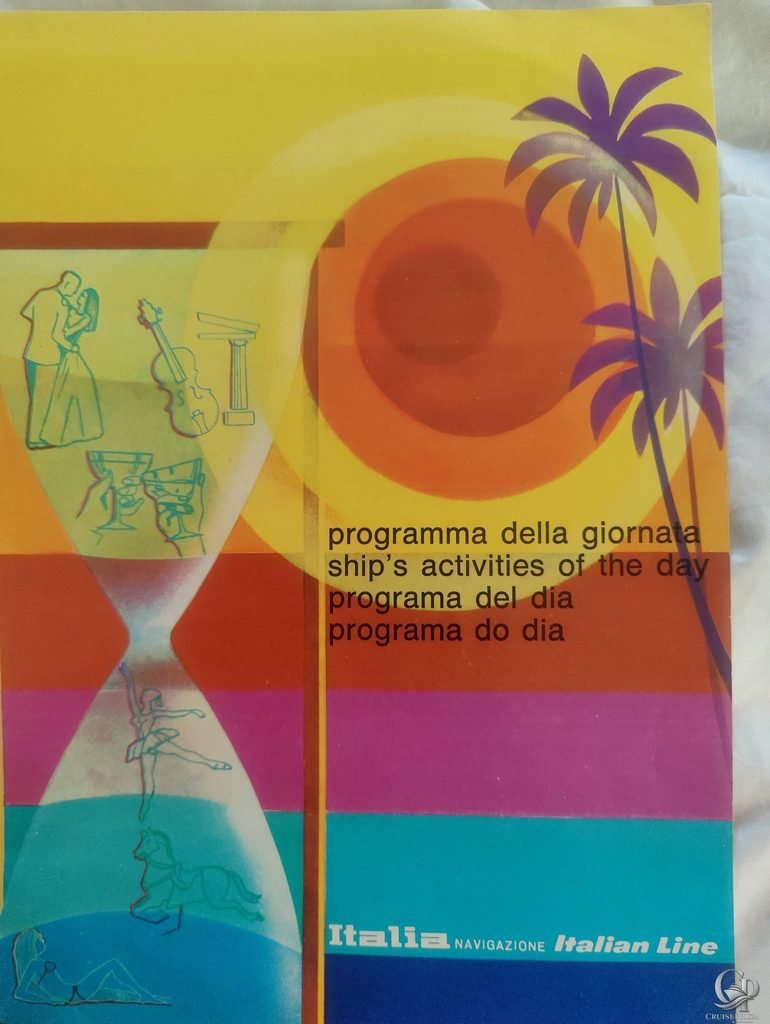
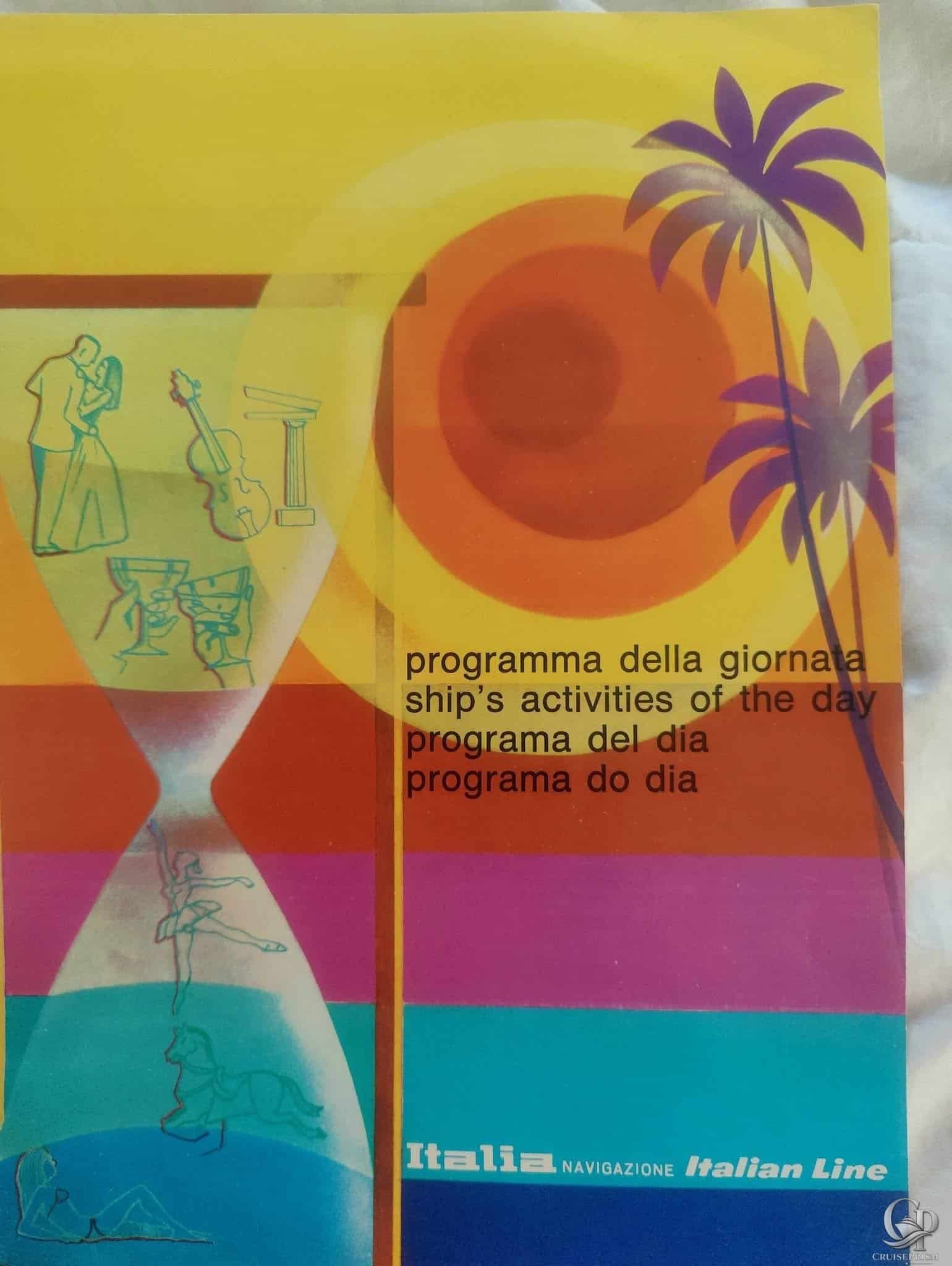
The cover of this surviving daily program immediately reflects the visual style of 1970s leisure travel. Bright yellow, orange, red, pink, turquoise, and blue colors create a tropical design, complemented by palm trees and illustrations representing entertainment and recreation.
The document identifies itself in four languages:
- Italian: Programma della giornata
- English: Ship’s activities of the day
- Spanish: Programa del día
- Portuguese: Programa do dia
This multilingual presentation reflects the international character of the Italian Line, officially known as Italia Navigazione.
The cover also features the Italia Navigazione and Italian Line branding, connecting the document to one of Italy’s most recognizable historic passenger shipping companies.
Unlike modern cruise planners, which often emphasize individual restaurants, specialty attractions, and digital reservations, this printed program presents the ship’s daily activities as a shared experience for passengers.
SS Raffaello: One of Italy’s Great Ocean Liners
The SS Raffaello was one of the final major ocean liners built for the Italian Line. Constructed by Cantieri Riuniti dell’Adriatico at Monfalcone, Italy, the ship entered service in 1965 alongside its sister ship, SS Michelangelo.
Both vessels represented a major investment in Italian passenger shipping at a time when commercial aviation was increasingly challenging traditional transatlantic travel.
Raffaello was a large, modern passenger liner of approximately 45,000 gross register tons, designed for the North Atlantic service connecting Italy and the United States. Its interiors, public rooms, and passenger facilities reflected the Italian Line’s emphasis on contemporary design, hospitality, and comfort.
By the 1970s, however, the economics of ocean travel had changed considerably. Long-distance passenger voyages were increasingly being replaced by air transportation, while leisure cruising was becoming a more important part of the passenger shipping industry.
The February 1975 program documents Raffaello operating a West Indies cruise rather than its traditional transatlantic service.
This distinction makes the document especially interesting: it captures the ship during the final period of its Italian Line career, when a vessel originally designed for scheduled ocean crossings was also being used for tropical leisure cruising.
February 10, 1975: A Day Aboard SS Raffaello
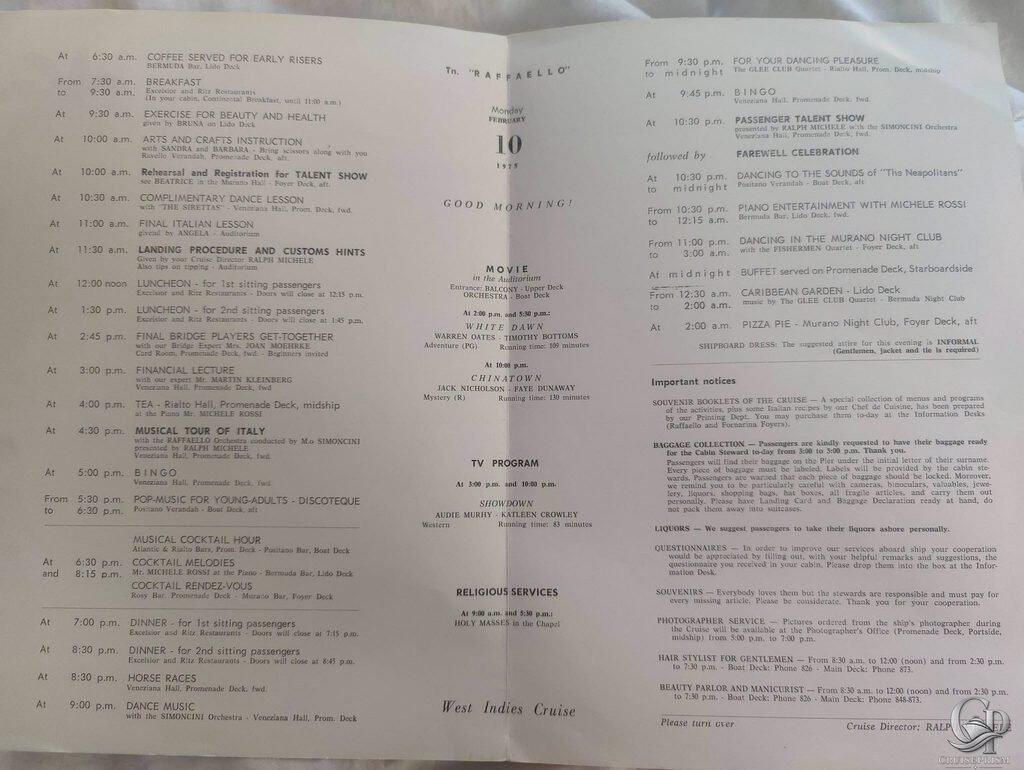
The inside pages identify the ship as Raffaello, with the date Monday, February 10, 1975, and the voyage described as a West Indies Cruise.
The program begins early in the morning and continues well past midnight, offering passengers an extensive selection of recreational, educational, social, and entertainment activities.
Rather than focusing exclusively on large theatrical productions, the schedule reveals an environment in which music, dancing, lectures, films, games, and organized social gatherings were central to the onboard experience.
The program also names Cruise Director Ralph Michele, whose responsibilities included presenting activities and helping coordinate the ship’s entertainment.
Morning Activities: Exercise, Crafts, Dancing, and Italian Lessons
The day began at 6:30 a.m. with coffee served for early risers at the Bermuda Bar on the Lido Deck.
Breakfast followed between 7:30 and 9:30 a.m. in the Excelsior and Ritz restaurants. The program also mentions continental breakfast served in passenger cabins until 11:00 a.m.
Morning activities included:
- 9:30 a.m. – Exercise for beauty and health, presented by Bruna on the Lido Deck.
- 10:00 a.m. – Arts and crafts instruction, featuring sessions with Sandra and Barbara.
- 10:00 a.m. – Rehearsal and registration for the passenger talent show.
- 10:30 a.m. – Complimentary dance lesson with the Sirettas.
- 11:00 a.m. – Final Italian lesson, presented by Angela.
- 11:30 a.m. – Landing procedures and customs information, presented by Cruise Director Ralph Michele.
The range of morning activities is notable. Passengers could participate in physical exercise, learn creative skills, practice dancing, or attend a language lesson.
The final Italian lesson also reflects the cultural identity of the ship, providing an opportunity for passengers to engage with the language associated with the Italian Line.
The landing procedures and customs presentation indicates that practical travel information was also part of the daily schedule. However, the surviving pages do not identify the specific port associated with this briefing.
Dining Aboard Raffaello: The Excelsior and Ritz Restaurants
Dining was a major part of the daily routine aboard Raffaello, and the February 10 program provides a clear picture of the ship’s scheduled meal arrangements.
Two restaurants are specifically identified: the Excelsior and the Ritz.
Lunch and dinner were organized into two passenger sittings, a traditional dining arrangement common aboard ocean liners and cruise ships of the period.
The printed schedule lists:
- Breakfast: 7:30–9:30 a.m.
- First lunch sitting: 12:00 noon.
- Second lunch sitting: 1:30 p.m.
- First dinner sitting: 7:00 p.m.
- Second dinner sitting: 8:30 p.m.
The program specifies restaurant door-closing times for lunch and dinner, emphasizing the structured nature of onboard dining.
Passengers assigned to the first lunch sitting were expected to arrive before 12:15 p.m., while those attending the second sitting had until 1:45 p.m.
For dinner, the corresponding door-closing times were 7:15 p.m. and 8:45 p.m.
This arrangement contrasts with the greater flexibility available on many contemporary cruise ships, where passengers may have access to open seating, casual dining venues, and extended restaurant hours.
The surviving program does not include the day’s restaurant menus, so it cannot establish which dishes were served on February 10.
Nevertheless, the dining schedule provides valuable evidence of how meals were organized aboard the ship.
Afternoon Entertainment: Lectures, Music, and Social Gatherings
The afternoon schedule reveals a mixture of cultural presentations, recreational games, and musical entertainment.
At 2:45 p.m., passengers could attend a final bridge players’ gathering with bridge expert Mrs. Joan Moehrke. Beginners were also invited.
At 3:00 p.m., Mr. Martin Kleinberg presented a financial lecture in the Venezia Hall.
The inclusion of a financial lecture is an interesting reminder that ocean-liner entertainment was not limited to music, dancing, and games. Educational and informational presentations also formed part of the passenger experience.
At 4:00 p.m., tea was served in the Rialto Hall, accompanied by pianist Michele Rossi.
A half hour later, the Raffaello Orchestra presented a Musical Tour of Italy, conducted by Maestro Simoncini and introduced by Ralph Michele.
The afternoon concluded with bingo at 5:00 p.m., followed by a pop-music discotheque for young adults from 5:30 to 6:30 p.m.
Together, these activities illustrate the variety of experiences offered aboard the ship. Passengers could enjoy traditional afternoon tea, listen to an orchestral performance, participate in organized games, or attend a more contemporary music event.
Movies and Television Aboard Raffaello in 1975
One of the most interesting features of this historic daily program is its dedicated movie and television schedule.
Films were presented in the ship’s Auditorium, with the entrance listed at the Balcony on the Upper Deck, Orchestra on the Boat Deck.
Two feature films were scheduled:
- White Dawn – Screenings at 2:00 p.m. and 5:30 p.m., listed as an adventure film starring Warren Oates and Timothy Bottoms, with a running time of 109 minutes.
- Chinatown – Screening at 10:00 p.m., starring Jack Nicholson and Faye Dunaway, listed as a mystery with a running time of 130 minutes.
The selection is particularly interesting because both films were relatively recent releases in February 1975.
The program also includes a separate television presentation:
- Showdown – Scheduled at 3:00 p.m. and 10:00 p.m., starring Audie Murphy and Kathleen Crowley, with a running time of 83 minutes.
These listings demonstrate how passenger entertainment incorporated contemporary cinema alongside traditional live performances.
For travelers accustomed to modern cruise ships with extensive on-demand entertainment libraries, the fixed movie schedule offers an interesting comparison.
Passengers aboard Raffaello selected from specific screenings announced in the daily program, making film attendance another scheduled part of life at sea.
Evening Entertainment: Dancing, Bingo, and the Passenger Talent Show
As evening approached, the schedule shifted toward cocktail gatherings, music, dancing, and organized entertainment.
The ship offered several musical settings before dinner, including cocktail melodies performed by pianist Michele Rossi at the Bermuda Bar and additional cocktail gatherings in the public lounges.
At 8:30 p.m., passengers could attend horse races in the Venezia Hall. The program does not describe the format of this activity, so it should not be confused with actual equestrian racing.
Dance music with the Simoncini Orchestra began at 9:00 p.m. in the Venezia Hall.
Later entertainment included:
- 9:30 p.m.–midnight – Dancing for your pleasure with the Glee Club Quartet in the Rialto Hall.
- 9:45 p.m. – Bingo in the Venezia Hall.
- 10:30 p.m. – Passenger Talent Show, presented by Ralph Michele with the Simoncini Orchestra.
- 10:30 p.m.–midnight – Dancing to the sound of The Neapolitans at the Positano Verandah.
- 10:30 p.m.–12:15 a.m. – Piano entertainment with Michele Rossi at the Bermuda Bar.
- 11:00 p.m.–3:00 a.m. – Dancing in the Murano Night Club with the Fishermen Quartet.
The Passenger Talent Show was followed by a Farewell Celebration, according to the printed program.
This sequence suggests a particularly festive evening, although the document does not establish the exact end date of the cruise.
The variety of entertainment venues is striking. Rather than concentrating all evening activities in a single theater, Raffaello offered passengers multiple lounges and musical performances operating at overlapping times.
Guests could choose between orchestra music, piano entertainment, dancing, bingo, or the passenger talent show.
Midnight Buffets and Late-Night Cruising Traditions
The February 10 schedule includes several late-night dining and entertainment arrangements.
A buffet was scheduled at midnight on the Promenade Deck, starboard side.
The program also lists the Caribbean Garden on the Lido Deck from 12:30 to 2:00 a.m., with music by the Glee Club Quartet.
At 2:00 a.m., a Pizza Pie event was scheduled in the Murano Night Club.
These late-night offerings reflect a cruising tradition in which food and entertainment continued well beyond the regular dinner service.
The midnight buffet, in particular, became a recognizable feature of classic cruise vacations.
For passengers aboard Raffaello in February 1975, the day’s activities could extend from early morning coffee to dancing and refreshments in the early hours of the following day.
Dress Codes and Formality Aboard the Italian Line
The program includes a specific evening dress recommendation:
Shipboard dress: Informal. Gentlemen were required to wear a jacket and tie.
This detail offers valuable historical context about passenger expectations.
Although the evening was classified as informal, the stated requirement for gentlemen was more structured than the casual dress commonly accepted in many modern cruise dining venues.
The terminology also illustrates how dress classifications have changed over time. An informal evening aboard a luxury ocean liner in 1975 did not necessarily correspond to today’s understanding of casual attire.
The surviving pages do not provide the dress requirements for other evenings of the voyage, so this information applies specifically to the date shown.
Passenger Services, Religious Observances, and Practical Information
Beyond entertainment and dining, the daily program included practical announcements intended to help passengers prepare for the remainder of their voyage.
Religious services were scheduled in the ship’s chapel, with Holy Mass at 9:00 a.m. and 5:30 p.m.
The important notices section addressed several aspects of passenger arrangements, including:
- Baggage collection and instructions for labeling luggage.
- Customs procedures and baggage declaration forms.
- Passenger questionnaires and feedback.
- Souvenir purchases and the handling of misplaced articles.
- Photography orders and collection times.
- Hair stylist and beauty parlor appointments.
- Recommendations concerning passengers taking purchased liquor ashore.
One notice asked passengers to have their baggage ready for cabin steward collection between 3:00 and 5:00 p.m.
The program also advertised souvenir booklets containing menus and programs from the cruise, along with Italian recipes prepared by the ship’s chef.
This is a particularly interesting historical detail because it demonstrates that the Italian Line recognized the appeal of cruise memorabilia even while the voyages were taking place.
Printed menus and daily programs were not merely disposable schedules. They could also become keepsakes of a passenger’s voyage.
Today, surviving examples provide a documentary record of shipboard life that would otherwise be difficult to reconstruct.
What This 1975 Daily Program Reveals About Classic Cruising
The Raffaello schedule provides several useful insights into how cruising operated during the 1970s.
First, passenger activities were highly organized. Dining, entertainment, films, lectures, and social gatherings followed a published timetable.
Second, live music played a prominent role throughout the day. Pianists, orchestras, and smaller musical groups performed in several public rooms.
Third, the entertainment program blended traditional ocean-liner activities with more contemporary offerings. Afternoon tea and orchestral performances appeared alongside discotheque music, television films, and passenger talent shows.
Fourth, passengers had access to a wide range of public venues. The program identifies the Venezia Hall, Rialto Hall, Bermuda Bar, Positano Verandah, Murano Night Club, and other onboard locations.
Finally, the document demonstrates how printed daily programs functioned as essential passenger guides.
Before modern cruise apps and interactive schedules, passengers relied on these publications to plan meals, entertainment, and other activities.
In that sense, Raffaello’s 1975 daily program served much the same purpose as a modern cruise planner or Cruise Compass equivalent, even though its presentation and onboard experience belonged to a very different era.
The Historical Significance of Raffaello’s Final Years
The February 1975 program dates from a particularly important period in the history of the Italian Line.
Raffaello and Michelangelo were among the last great Italian transatlantic liners, built during a period when traditional passenger shipping was already facing intense competition from commercial aviation.
Their sophisticated designs and luxurious interiors represented an ambitious effort to maintain the appeal of ocean travel.
However, the financial pressures affecting the transatlantic passenger market ultimately proved difficult to overcome.
The Italian Line withdrew Raffaello and Michelangelo from service in 1975.
Raffaello was subsequently sold to Iran, where it was used as an accommodation vessel. The ship was later damaged during the Iran–Iraq War and never returned to passenger service.
Because the surviving daily program is dated February 10, 1975, it documents the ship during the final year of its Italian Line operations.
Its significance therefore extends beyond the individual activities listed on the page. It preserves a moment near the end of an important chapter in Italian maritime history.
Frequently Asked Questions About the SS Raffaello 1975 Daily Program
What ship is featured in this historic cruise program?
The document belongs to SS Raffaello, an Italian Line ocean liner that entered service in 1965 and was withdrawn from service in 1975.
What is the date of the program?
The program is dated Monday, February 10, 1975.
What itinerary was Raffaello sailing?
The document identifies the voyage as a West Indies Cruise. However, the photographed pages do not provide a complete itinerary or identify all ports visited.
Who was the cruise director aboard Raffaello?
Ralph Michele is identified as the cruise director in the February 10, 1975 program.
What restaurants were available aboard Raffaello?
The daily program identifies the Excelsior and Ritz restaurants as the venues for breakfast, lunch, and dinner.
Did Raffaello have a movie theater?
The program lists film screenings in the ship’s Auditorium, including White Dawn and Chinatown.
Did the ship offer a midnight buffet?
Yes. A midnight buffet was scheduled on the Promenade Deck, starboard side, on February 10, 1975.
Was there a dress code aboard Raffaello?
Yes. The program designated the evening as informal but required gentlemen to wear a jacket and tie.
What entertainment was available aboard Raffaello?
The February 10 schedule included orchestral music, dancing, bingo, bridge, lectures, Italian lessons, arts and crafts, films, a passenger talent show, and late-night musical performances.
Why are original Italian Line daily programs collectible?
They preserve firsthand information about shipboard activities, passenger services, dining arrangements, entertainment, and historic cruise traditions. Programs from the final operating years of famous ocean liners are especially useful as records of maritime history.
Conclusion: A Rare Glimpse Into Life Aboard SS Raffaello

The February 10, 1975, daily program from SS Raffaello is more than a schedule of passenger activities. It is a surviving record of an era when Italian ocean liners combined traditional maritime hospitality with the emerging culture of modern leisure cruising.
From early morning coffee and Italian lessons to orchestral concerts, passenger talent shows, midnight buffets, and dancing until 3:00 a.m., the document reveals a full day of organized entertainment aboard one of Italy’s most famous passenger ships.
It also captures Raffaello during the final year of its Italian Line career, giving the program additional historical importance.
For maritime enthusiasts, cruise memorabilia collectors, and travelers interested in the evolution of cruising, this original daily program offers an authentic glimpse into what a West Indies voyage aboard SS Raffaello looked like in February 1975.