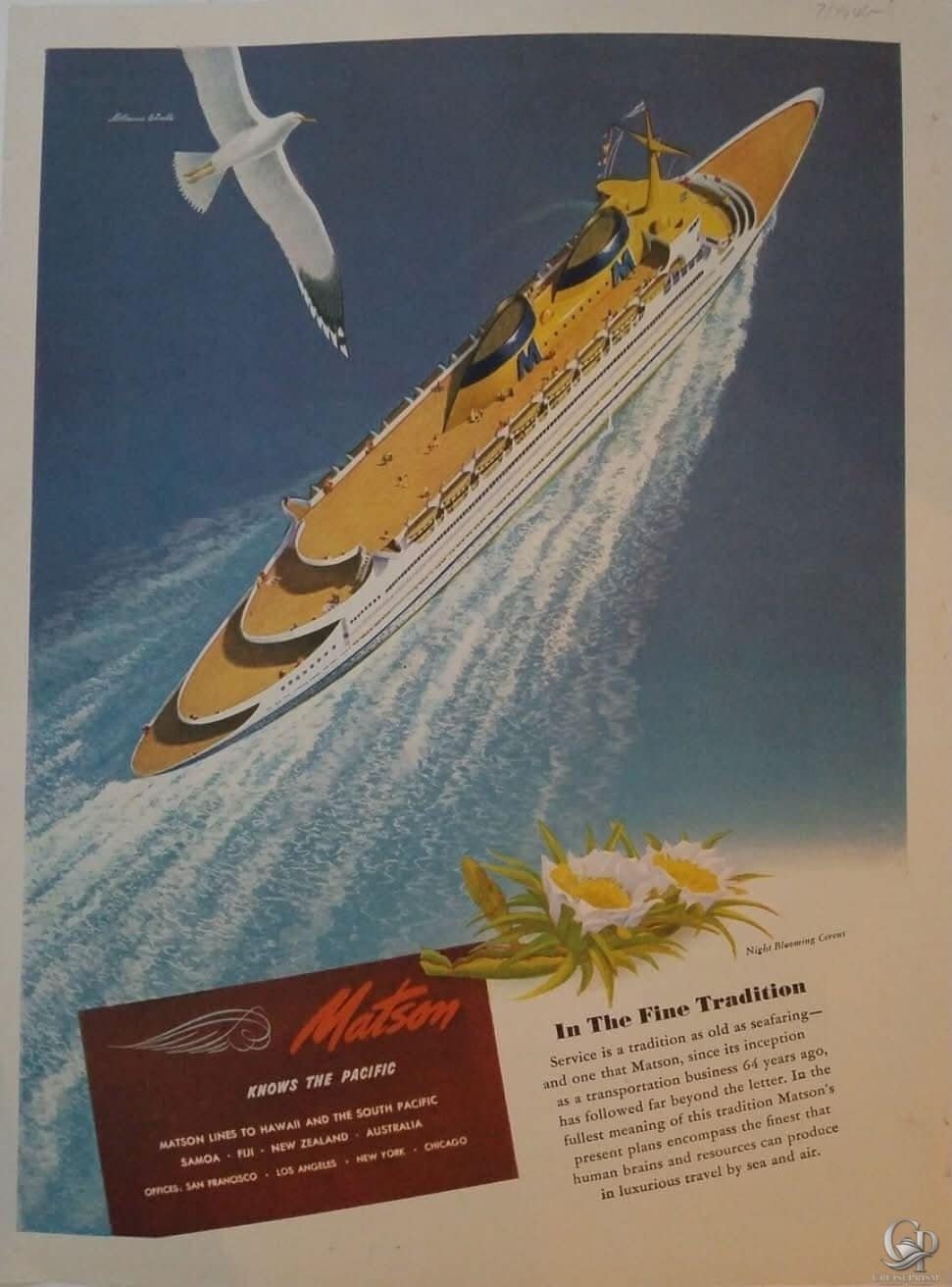
Vintage Matson Lines Advertisement: The Golden Age of Pacific Ocean Travel
Long before modern cruise ships transformed vacations at sea, Matson Lines helped define luxury ocean travel across the Pacific. Its elegant passenger liners connected the United States with Hawaii, Samoa, Fiji, New Zealand, and Australia, offering travelers an experience that combined transportation with comfort, service, and adventure.
This vintage Matson advertisement captures that era through a dramatic illustration of an ocean liner sailing across deep blue water, accompanied by a soaring seabird and tropical flowers. Its message, “Matson Knows the Pacific,” reflects the company’s longstanding association with travel across the Pacific Ocean.
For anyone interested in historic cruise ships, vintage ocean liner advertisements, or the evolution of passenger travel, this artwork offers a fascinating glimpse into how luxury voyages were marketed before the modern cruise industry emerged.
A Closer Look at the Vintage Matson Advertisement
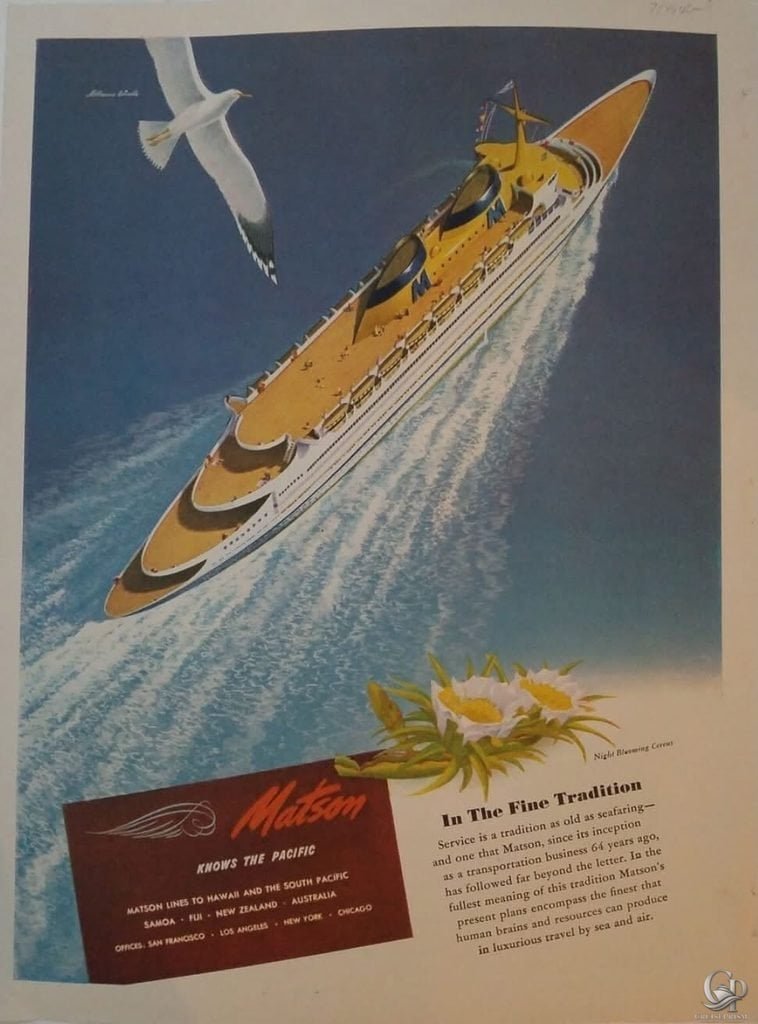
The advertisement features a large passenger liner viewed from above, traveling diagonally across a dark blue ocean.
Its long white hull, warm-colored decks, prominent funnel, and streamlined appearance emphasize the elegance of ocean travel during the era.
A large seabird flies above the ship, while tropical flowers appear in the foreground.
The composition combines maritime imagery with natural elements associated with the Pacific, creating an atmosphere of exploration and luxury.
Near the bottom of the advertisement, the company’s familiar Matson branding appears alongside the slogan:
“Matson Knows the Pacific.”
The advertisement also identifies several destinations served by Matson Lines:
- Hawaii
- Samoa
- Fiji
- New Zealand
- Australia
The listed company offices include San Francisco, Los Angeles, New York, and Chicago.
Rather than advertising a particular departure date or ticket price, the illustration promotes the overall experience of traveling aboard Matson’s passenger ships.
The Advertisement’s Message: In the Fine Tradition
One of the most interesting features is the paragraph titled “In The Fine Tradition.”
The text emphasizes Matson’s history in transportation and its commitment to luxurious travel by sea and air.
It refers to the company’s transportation business as having begun 65 years earlier, although the advertisement itself does not display a clearly readable publication date.
The message focuses on tradition, service, and the company’s ambition to provide comfortable long-distance transportation.
This style of advertising was common during the golden age of passenger liners, when shipping companies competed not only through routes and schedules but also through reputation, service, and onboard accommodations.
The emphasis on tradition helped present ocean travel as an established and prestigious way to cross the Pacific.
When Was This Matson Advertisement Published?
The advertisement can be placed in the mid-1940s, and a historical ocean liner advertising catalog identifies a matching Matson advertisement titled “In the Fine Tradition” as dating to approximately 1945.
The catalog describes it as a color advertisement featuring an aerial Art Deco illustration of an ocean liner and seagulls.
This is consistent with the artwork in the photograph, although the exact publication date and original magazine have not been established.
The advertisement’s reference to 65 years of transportation history also fits the period. Matson traces its beginnings to 1882, placing its 65th anniversary in 1947.
Together, these details suggest that the advertisement belongs to the immediate post-World War II period, when Matson was preparing to restore its reputation for luxury passenger travel.
The History of Matson Lines
Matson’s history began in 1882 when Captain William Matson sailed the three-masted schooner Emma Claudina from San Francisco to Hilo, Hawaii.
The vessel carried approximately 300 tons of food, plantation supplies, and general merchandise.
What began as a freight operation eventually developed into one of the Pacific’s most recognizable shipping companies.
As Matson expanded, it became increasingly involved in passenger transportation and tourism.
By the early twentieth century, the company was helping establish regular connections between California, Hawaii, and other Pacific destinations.
Matson also played an important role in developing Hawaii as a vacation destination, including its association with the famous Royal Hawaiian Hotel.
During the 1920s and 1930s, the company’s passenger liners became closely associated with comfortable ocean crossings, tropical vacations, and elegant shipboard accommodations.
Matson’s Famous White Passenger Liners
Among the most recognizable vessels in Matson’s history were the luxury liners often associated with its famous White Ships.
These included:
- SS Malolo: Entered service in 1927 and was later renamed Matsonia.
- SS Lurline: The celebrated 1932 passenger liner associated with luxury voyages between California and Hawaii.
- SS Mariposa: A 1930s passenger liner serving Hawaii and South Pacific destinations.
- SS Monterey: A sister ship of Mariposa that also operated on Pacific passenger routes.
These vessels represented an important period in American maritime history.
Their long white hulls and distinctive profiles became familiar sights in Pacific ports.
Matson’s ships carried travelers on journeys that could involve several days at sea, with onboard dining, social activities, and comfortable accommodations forming an important part of the experience.
The advertisement’s illustrated vessel resembles the streamlined appearance associated with Matson’s passenger fleet. However, the advertisement does not identify the ship by name, so it cannot be conclusively attributed to a particular liner.
World War II and the Return of Luxury Ocean Travel
The Second World War dramatically interrupted Matson’s passenger operations.
Several of the company’s prominent passenger liners were converted for military transportation, replacing their peacetime role with the urgent demands of wartime service.
The Lurline, Mariposa, Monterey, and Matsonia all participated in wartime transportation operations.
After the war, restoring passenger service required considerable investment.
Ships that had been adapted for military purposes needed extensive work before returning to commercial service.
The Lurline eventually resumed passenger operations between California and Hawaii in April 1948 following a major refurbishment.
This historical background helps explain the advertisement’s emphasis on tradition and the future of luxurious travel.
Rather than simply promoting an existing sailing schedule, Matson was reinforcing its identity as a company with a long history and ambitions for the postwar travel market.
Matson’s Pacific Routes: Hawaii, Samoa, Fiji, New Zealand and Australia
The destinations listed in the advertisement reflect Matson’s extensive historical connections across the Pacific.
Its passenger services linked the American West Coast with tropical islands and major cities in the South Pacific.
Historical Matson schedules document routes involving:
- San Francisco, California
- Los Angeles, California
- Honolulu, Hawaii
- Pago Pago, American Samoa
- Suva, Fiji
- Auckland, New Zealand
- Sydney, Australia
- Melbourne, Australia
These destinations were not necessarily included together on every voyage, and the advertisement does not provide a specific itinerary.
Nevertheless, the geographic range demonstrates the importance of Matson’s passenger operations.
Unlike many modern cruises that return to their original departure port after a relatively short vacation, historic ocean liner services often functioned as long-distance transportation between continents and island destinations.
Passengers could travel across the Pacific while enjoying accommodations and services associated with luxury travel.
The Art of Vintage Ocean Liner Advertising
One of the most appealing aspects of this advertisement is its illustration.
The artist uses an elevated perspective to make the ship appear long, elegant, and powerful.
The ocean liner dominates the composition, while the white wake emphasizes its movement across the water.
The seabird and tropical flowers provide a connection to the natural beauty of the Pacific.
The artwork also reflects the advertising style of the period, when shipping companies frequently commissioned elaborate illustrations rather than relying exclusively on photography.
These advertisements were designed to sell an experience.
They presented ocean travel as sophisticated, adventurous, and desirable, often emphasizing the romance of distant destinations.
Matson was particularly well known for its artistic promotional campaigns, which included work by prominent illustrators and photographers.
Today, surviving examples provide a visual record of how the company promoted passenger travel during the twentieth century.
Why Matson Advertisements Are Important to Cruise History
Matson’s passenger operations belong to an era when the distinction between transportation and leisure travel was changing.
Ocean liners were originally designed to carry passengers between destinations, but companies increasingly emphasized the pleasures of the voyage itself.
Comfortable accommodations, fine dining, entertainment, and attractive public spaces helped make long ocean crossings appealing.
These features would eventually become central to the modern cruise industry.
Matson’s marketing also helped establish Hawaii and the South Pacific as desirable vacation destinations for American travelers.
The company’s advertisements are therefore more than attractive examples of vintage commercial art.
They document an important chapter in the development of Pacific tourism and luxury passenger shipping.
What Happened to Matson’s Passenger Ships?
Matson continued operating passenger liners after World War II, but commercial aviation gradually transformed the transportation industry.
As air travel became faster and more accessible, fewer passengers needed to spend several days crossing the Pacific by ship.
The company eventually withdrew from the traditional passenger liner business.
Its famous vessels followed different paths, including sales to other shipping companies and subsequent service under new names.
The original 1932 Lurline, for example, was sold in 1963 and later operated as Ellinis.
Another former Matson liner, Monterey, subsequently became Matsonia and later took the name Lurline before entering service with Chandris as Britanis.
Matson itself survived the transition.
Today, the company continues operating as a major Pacific shipping business focused on freight transportation rather than luxury passenger cruises.
Collecting Vintage Matson Lines Advertisements
Original Matson advertisements remain of interest to collectors of maritime memorabilia, travel posters, and historic commercial artwork.
Surviving examples can appear as magazine advertisements, promotional prints, brochures, and other printed materials.
For collectors, several details are worth examining:
- Publication date: Identifying the original magazine or publication can help establish when the advertisement appeared.
- Artwork: Different campaigns featured distinctive illustrations, photography, and typography.
- Condition: Fading, stains, tears, trimming, and other damage can affect an original advertisement’s appeal.
- Originality: An authentic period magazine advertisement is different from a modern reproduction.
- Subject matter: Advertisements featuring recognizable ships or famous destinations may be particularly interesting to maritime enthusiasts.
The photographed advertisement shows an aged paper border and the appearance of a vintage printed page.
However, the photograph alone does not establish whether it is an original magazine advertisement, a later reproduction, or another type of printed item.
Frequently Asked Questions About Matson Lines
What was Matson Lines?
Matson Lines was the passenger shipping operation associated with Matson Navigation Company, an American shipping business established in the nineteenth century. It became particularly well known for its luxury passenger liners serving Hawaii and the South Pacific.
When was Matson founded?
Matson traces its history to 1882, when Captain William Matson began operating the schooner Emma Claudina between California and Hawaii.
How old is this Matson advertisement?
A historical advertising catalog identifies a matching “In the Fine Tradition” advertisement as dating to approximately 1945. The exact publication date of the photographed example has not been confirmed.
Which ship appears in the advertisement?
The advertisement depicts a large Matson-style passenger liner, but the vessel is not identified by name. It should not be attributed to a specific ship without additional documentation.
Did Matson operate cruises to Hawaii?
Yes. Matson operated passenger services between California and Hawaii and became famous for its luxurious ocean travel experience. The company also offered voyages involving South Pacific destinations.
What were Matson’s most famous passenger ships?
Some of the best-known vessels included Malolo, Lurline, Mariposa, Monterey, and Matsonia.
Does Matson still operate passenger cruises?
No. Matson remains active as a shipping company, but its modern operations focus on freight transportation rather than passenger cruises.
Are original Matson advertisements collectible?
Yes. Vintage Matson advertisements are collected as examples of maritime history, travel advertising, and twentieth-century commercial art.
Final Thoughts on This Vintage Matson Advertisement
This historic Matson Lines advertisement captures an era when ocean travel represented both an important form of transportation and an exciting luxury experience.

Its dramatic illustration of a passenger liner crossing the Pacific, combined with tropical imagery and the company’s recognizable branding, reflects the elegance and romance associated with the great ocean liners.
The advertisement is especially interesting because of its connection to Matson’s postwar history, when the company was looking toward the future while emphasizing decades of maritime tradition.
Although the exact publication date and identity of the illustrated vessel remain unconfirmed, the artwork provides a valuable glimpse into the marketing and visual culture of Pacific passenger shipping during the 1940s.
For cruise enthusiasts and maritime history collectors, advertisements like this preserve the memory of a time when traveling to Hawaii, Australia, and the South Pacific often meant boarding a beautiful ocean liner and spending days crossing the open sea.