Hurtigruten Kirkenes Dinner Menu: Day 7 of the Coastal Express
Hurtigruten’s dining experience is closely connected to the Norwegian coastline, and this Day 7 Kirkenes dinner menu is a particularly good example. The menu combines ingredients and culinary influences associated with Norway’s far north, including herring, Arctic char, honey and Sámi láibi, while also acknowledging Kirkenes’ proximity to Russia with a Russian borscht option.
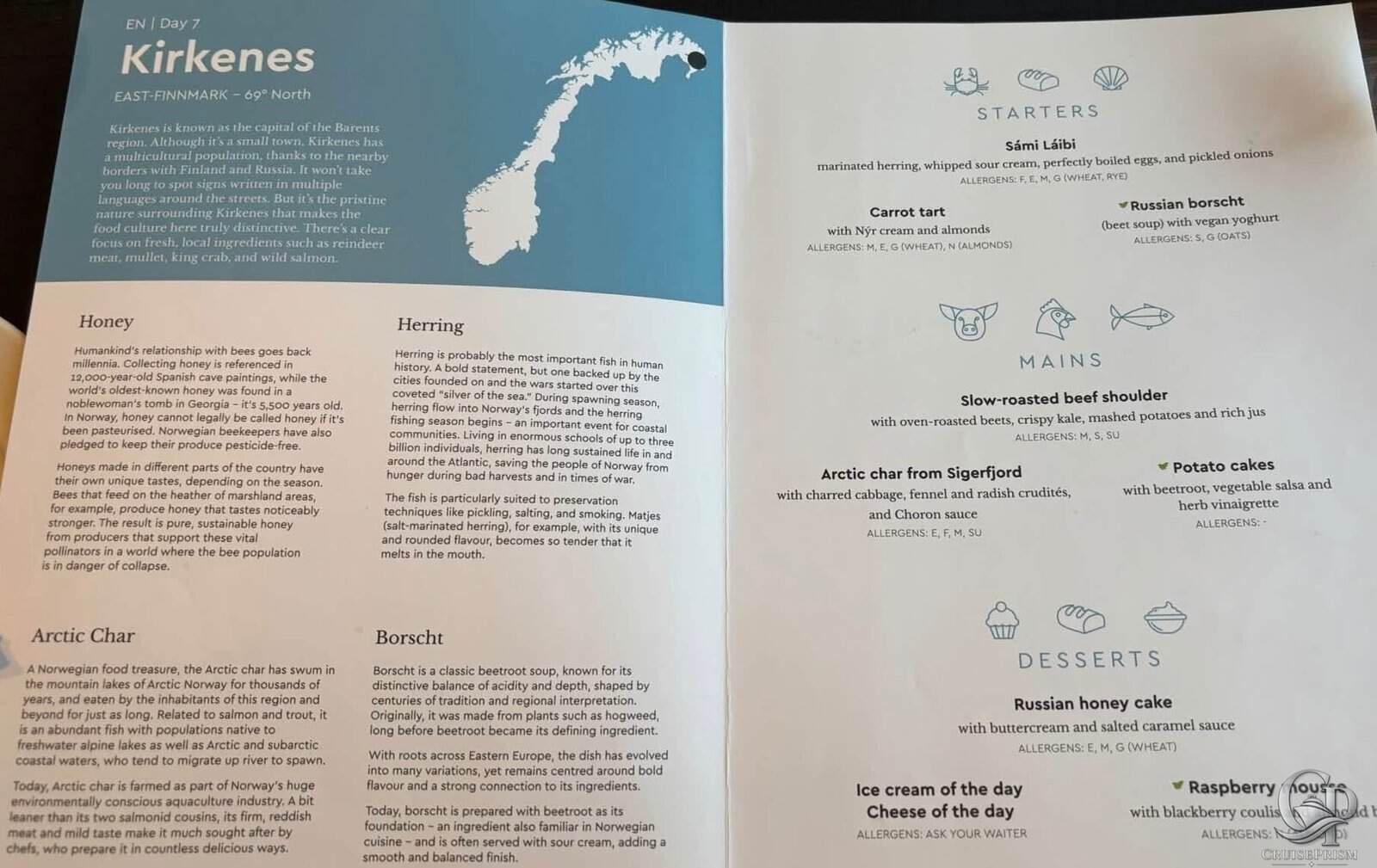
The menu is labeled “Kirkenes – East-Finnmark – 69° North” and explains that Kirkenes is known as the capital of the Barents region. It highlights the multicultural character of the town, its location near the Finnish and Russian borders, and local ingredients such as reindeer, mullet, king crab and wild salmon.
For more dining information before sailing, CruisePrism readers can also explore our Hurtigruten Dining Menus, and Hurtigruten Onboard Guides for additional information about food and life aboard the Norwegian coastal ships.
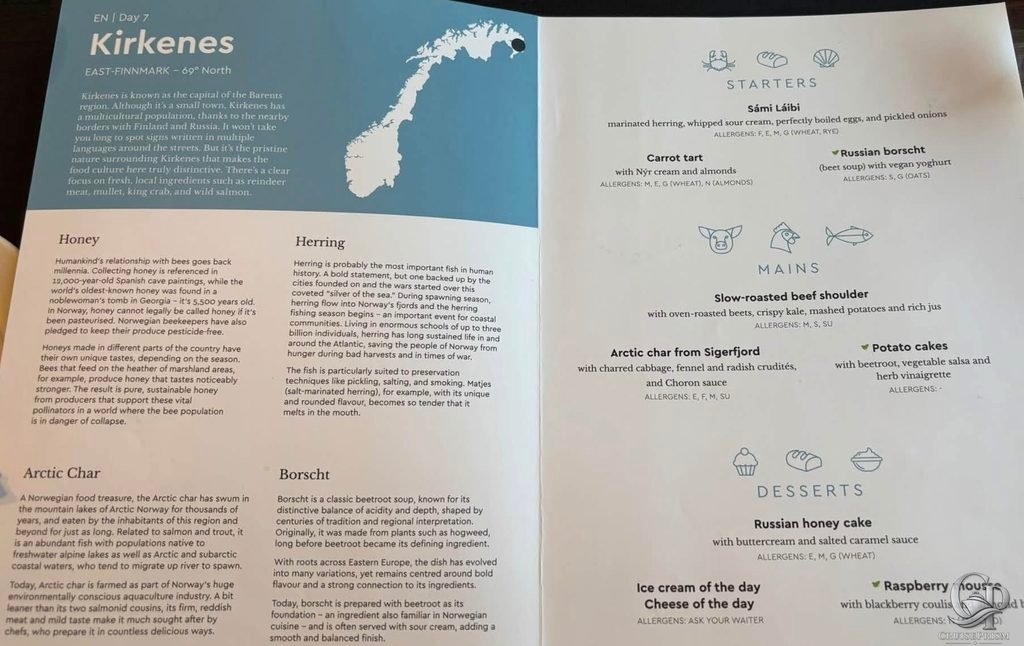
Hurtigruten’s Kirkenes Day 7 Menu
The photographed menu comes from Day 7 of a Hurtigruten voyage and is themed around Kirkenes in East Finnmark at approximately 69° North.
This fits directly with Hurtigruten’s Coastal Express itinerary. The classic northbound Coastal Express travels from Bergen to Kirkenes over seven days, while the complete roundtrip continues back south to Bergen. Hurtigruten currently describes Kirkenes as the northern endpoint of the northbound journey.
The dinner itself follows a three-course format with multiple choices for starters, mains and desserts.
Starters
Three starters appear on the Kirkenes menu:
- Sámi Láibi – marinated herring, whipped sour cream, perfectly boiled eggs and pickled onions
- Carrot tart – with Nýr cream and almonds
- Russian borscht – beet soup with vegan yoghurt
The Russian borscht is marked as a plant-based selection.
The combination is closely tied to the region represented by the menu. Herring has a long history in Norwegian coastal communities, while the borscht provides a nod to the Russian influence that is particularly relevant in Kirkenes.
Sámi Láibi and Herring
One of the most distinctive starters is Sámi Láibi served with marinated herring.
The menu dedicates a section to explaining herring’s historical importance. It describes the fish as one of the most important in human history and notes the enormous schools that once filled Norway’s fjords during spawning season.
Herring became an important food source for coastal communities and is particularly well suited to preservation methods such as pickling, salting and smoking.
The menu specifically discusses matjes, or salt-marinated herring, describing its rounded flavor and exceptionally tender texture.
This background turns the starter into more than simply another seafood dish. It connects dinner to the coastal food traditions that Hurtigruten emphasizes throughout its Norwegian voyages.
Russian Borscht in Kirkenes
The presence of Russian borscht makes particular sense on a Kirkenes-themed menu.
Kirkenes sits in Norway’s far northeast near the Russian border, and the menu itself describes the community as multicultural due to its proximity to both Russia and Finland.
The borscht served on this menu is a beet soup accompanied by vegan yoghurt.
The accompanying menu text explains that borscht has developed into numerous variations across Eastern Europe and that modern versions center strongly on beetroot, producing its recognizable color and combination of acidity and depth.
It is also one of the plant-based choices on this dinner menu.
Hurtigruten Kirkenes Main Courses
Guests have three main-course choices:
- Slow-roasted beef shoulder – with oven-roasted beets, crispy kale, mashed potatoes and rich jus
- Arctic char from Sigerfjord – with charred cabbage, fennel and radish crudités, and Choron sauce
- Potato cakes – with beetroot, vegetable salsa and herb vinaigrette
The potato cakes are marked as a plant-based option.
Together, the three dishes provide a meat, fish and plant-based choice, which is consistent with Hurtigruten’s current approach at Torget, where dinner menus offer selections across those categories.
Arctic Char from Sigerfjord
The Arctic char is arguably the most regionally distinctive main course.
The menu describes Arctic char as a Norwegian food treasure that has inhabited the mountain lakes of Arctic Norway for thousands of years. Related to salmon and trout, Arctic char can be found in both freshwater alpine lakes and Arctic and sub-Arctic coastal waters.
For this dinner, the fish is identified specifically as Arctic char from Sigerfjord and is served with charred cabbage, fennel and radish crudités, finished with Choron sauce.
Hurtigruten continues to highlight Arctic char as one of the ingredients passengers can encounter while traveling Norway’s coast.
Slow-Roasted Beef Shoulder
For guests who prefer meat, the alternative is slow-roasted beef shoulder.
It is served with:
- Oven-roasted beets
- Crispy kale
- Mashed potatoes
- Rich jus
The dish is the most traditional meat-and-potatoes option among the three entrées, while the beets and kale maintain the menu’s emphasis on Nordic ingredients.
Plant-Based Potato Cakes
The plant-based main course consists of potato cakes accompanied by beetroot, vegetable salsa and herb vinaigrette.
Hurtigruten currently emphasizes plant-based alternatives as part of its Norway’s Coastal Kitchen program, and its main Coastal Express restaurant offers vegan selections alongside fish and meat dishes.
The Kirkenes menu follows that format with clearly identified plant-based options among both the starters and main courses.
Hurtigruten Kirkenes Desserts
The Day 7 menu offers three desserts:
- Russian honey cake – with buttercream and salted caramel sauce
- Ice cream of the day – guests are instructed to ask their waiter about the flavor
- Raspberry mousse – with blackberry coulis and almond
The raspberry mousse is marked as plant-based.
Once again, the Russian influence appears in the meal through the Russian honey cake, complementing the borscht offered at the beginning of dinner.
Honey and the Norwegian Connection
The menu devotes additional space to honey and its role in Norway.
It explains that honey has been collected by humans for thousands of years and notes that Norwegian honey cannot legally be called honey if it has been pasteurized.
The menu also discusses how honey produced in different regions can develop distinctive flavors depending on the season and the plants available to bees.
This background provides additional context for the Russian honey cake served for dessert while continuing the menu’s broader focus on ingredients rather than simply presenting a list of dishes.
Norway’s Coastal Kitchen
This menu fits Hurtigruten’s broader Norway’s Coastal Kitchen concept.
Hurtigruten describes the philosophy as serving food that reflects the coast through which its ships are traveling. The company sources ingredients from farms, fisheries, bakeries and other suppliers along Norway’s coastline, and menus change according to location and season.
On Original Coastal Express voyages, Hurtigruten says ingredients are collected at numerous ports along the route.
That approach helps explain why this particular dinner isn’t simply labeled as a generic Day 7 menu. Kirkenes and East Finnmark are an integral part of its presentation.
The ingredients, regional background and accompanying stories are designed to connect the meal with where the ship is traveling.
Where Is This Dinner Served?
On Hurtigruten’s Original Coastal Express ships, Torget is the main restaurant.
Torget serves breakfast, lunch and dinner, with dinner generally presented as a three-course meal offering different dishes throughout the voyage. Hurtigruten says guests can expect choices incorporating meat, fish and plant-based dishes.
That structure matches the photographed Kirkenes menu closely.
Hurtigruten’s Original Coastal Express fleet includes several ships, and the specific ship is not identified anywhere on this photographed menu. For that reason, this menu should not be attributed to a particular Hurtigruten ship without additional documentation.
Hurtigruten Coastal Express Dining
The Original Coastal Express operates along the Norwegian coast between Bergen and Kirkenes, continuing a route Hurtigruten has served since 1893.
Hurtigruten currently lists several dining venues across its Original ships, including:
- Torget – main restaurant for breakfast, lunch and dinner
- Kysten – à la carte fine dining
- Brygga – casual bistro
- Multe – bakery and café
Exact facilities can depend on the ship.
For passengers traveling on the full Coastal Express, dining becomes part of the itinerary itself. The ingredients and menus evolve as the ship moves between different regions of Norway.
Kirkenes and the Coastal Express
Kirkenes marks a major point in the classic Hurtigruten journey.
The northbound Coastal Express travels from Bergen to Kirkenes over seven days, while passengers taking the full roundtrip continue from Kirkenes south toward Bergen.
Hurtigruten’s current Coastal Express itinerary specifically highlights Arctic ingredients such as Arctic char and king crab as examples of the regional foods passengers may encounter.
That makes the Day 7 Kirkenes menu especially representative of the Coastal Express concept: passengers have traveled from southern Norway into the Arctic, and the food served onboard changes to reflect that journey.
Frequently Asked Questions
What is on the Hurtigruten Kirkenes dinner menu?
The menu offers three starters, three main courses and three desserts. Choices include Sámi Láibi with marinated herring, Russian borscht, slow-roasted beef shoulder, Arctic char from Sigerfjord, potato cakes and Russian honey cake.
What day of the Hurtigruten cruise is this menu from?
The photographed menu is explicitly labeled Day 7.
Is Kirkenes Day 7 on the Hurtigruten Coastal Express?
Kirkenes is Day 7 of Hurtigruten’s classic northbound Coastal Express voyage from Bergen to Kirkenes.
What is the fish served on this menu?
The fish entrée is Arctic char from Sigerfjord, served with charred cabbage, fennel and radish crudités, and Choron sauce.
Does the menu have vegetarian or plant-based choices?
Yes. The Russian borscht, potato cakes and raspberry mousse are marked with the menu’s plant-based symbol.
What desserts are available?
The menu lists Russian honey cake with buttercream and salted caramel sauce, ice cream of the day, and raspberry mousse with blackberry coulis and almond.
Why does a Norwegian cruise menu include Russian dishes?
Kirkenes is in northeastern Norway close to the Russian border. The photographed menu specifically discusses the multicultural character of Kirkenes and incorporates that regional influence through dishes including Russian borscht and Russian honey cake.
Which Hurtigruten ship is this menu from?
The photograph does not identify the ship. Because Hurtigruten operates multiple ships on its Original Coastal Express route, it would not be accurate to assign this particular menu to a specific ship based solely on the available image.
What restaurant serves dinner on Hurtigruten’s Coastal Express?
Torget is the main restaurant aboard Hurtigruten’s Original Coastal Express ships and serves breakfast, lunch and dinner. Dinner typically consists of a three-course menu with meat, fish and plant-based choices.
Conclusion
This Hurtigruten Kirkenes Day 7 dinner menu captures the idea behind Norway’s Coastal Kitchen particularly well. Rather than serving the same generic cruise menu throughout the voyage, the meal is built around the region the ship has reached.
Sámi Láibi with marinated herring and Arctic char from Sigerfjord connect the meal with northern Norwegian food traditions, while Russian borscht and Russian honey cake reflect Kirkenes’ location and cultural connections near Norway’s eastern border. Slow-roasted beef and plant-based potato cakes provide alternatives for passengers who prefer something other than fish.
For travelers researching Hurtigruten menus before a Coastal Express cruise, this Kirkenes menu provides a useful example of what dinner can look like when the voyage reaches the far north—and how Hurtigruten uses food to tell the story of the Norwegian coast.