Carnival Sail & Sign Statement From 2009: A Look at Historic Cruise Prices
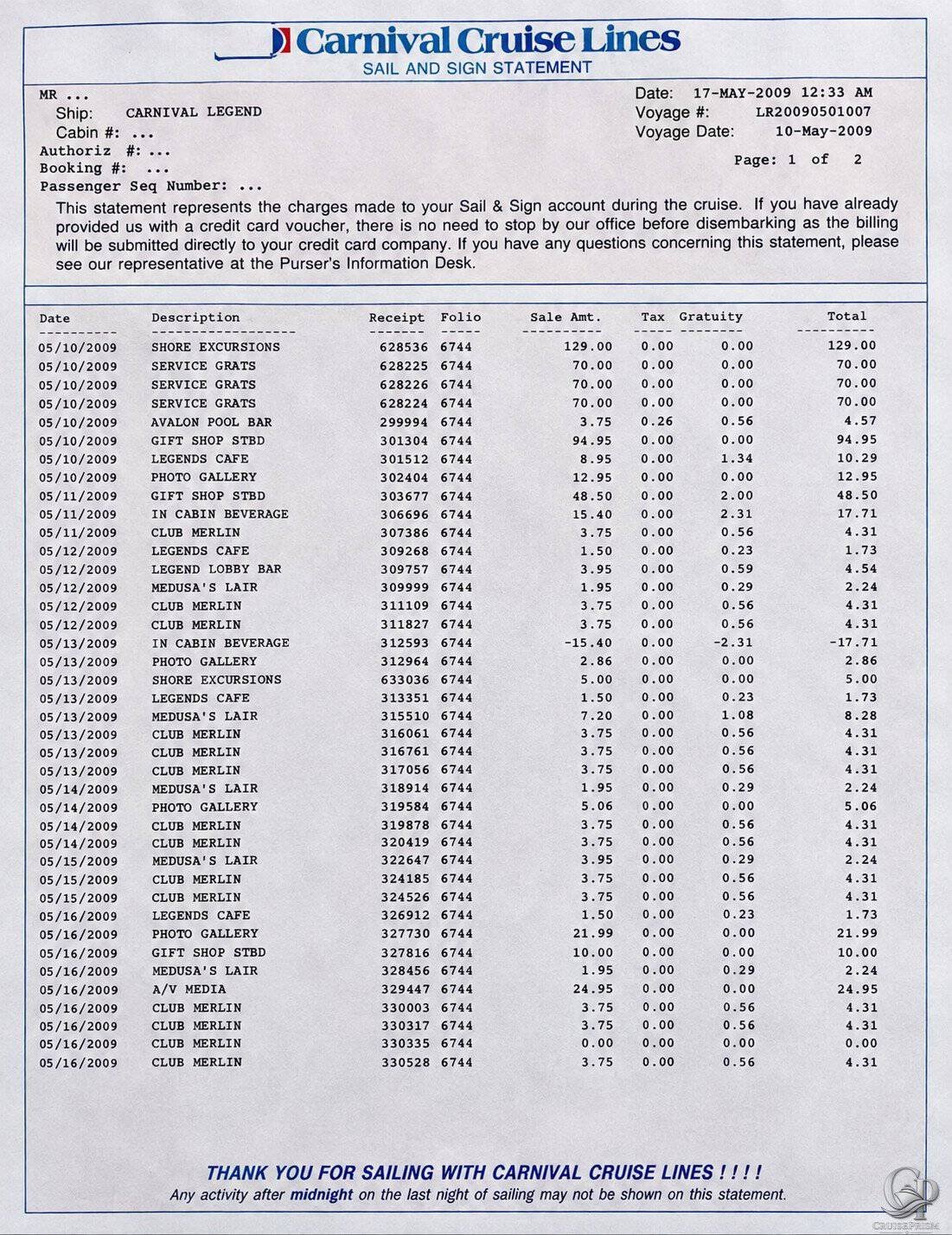
How much did passengers actually spend aboard a Carnival cruise ship in 2009? A surviving Sail & Sign statement from Carnival Legend offers a fascinating glimpse into cruise vacation expenses from more than 15 years ago.
The original document, dated May 17, 2009, records onboard purchases from a Carnival Legend sailing that began May 10, 2009. It includes bar charges, shore excursions, souvenir purchases, photographs, gratuities, and other expenses.
Some of the prices are particularly interesting: a $3.75 charge at Club Merlin, a $1.50 purchase at Legends Cafe, and a $70 service gratuity charge.
This historical cruise receipt provides a useful snapshot of what passengers paid for onboard purchases during an earlier era of Carnival cruising. It also shows how the cruise line’s cashless payment system worked before smartphones and cruise apps became part of the everyday cruise experience.
For more Carnival information, CruisePrism readers can also explore our Carnival Dining Menus, Carnival Drink Lists, and Carnival Onboard Guides for more information about restaurants, schedules and onboard activities.
Original Carnival Legend Sail & Sign Statement From May 2009
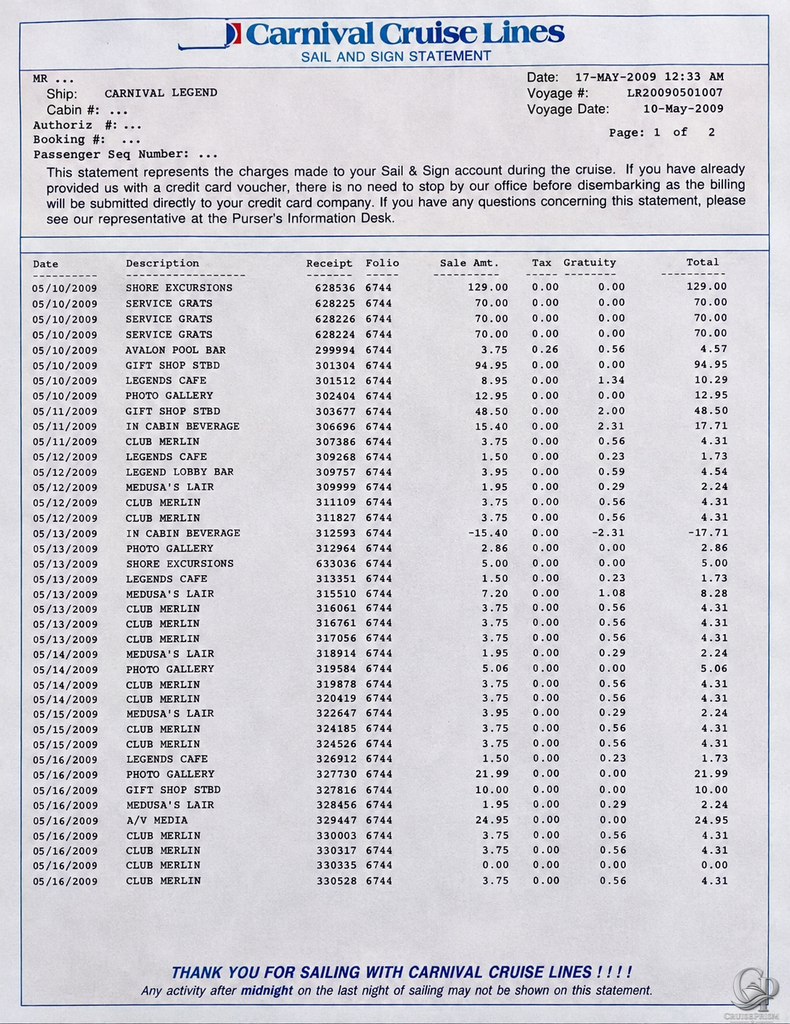
The photograph shows an original Carnival Cruise Lines Sail and Sign Statement printed at 12:33 AM on May 17, 2009.
Several details identify the document:
- Cruise line: Carnival Cruise Lines, now branded Carnival Cruise Line
- Ship: Carnival Legend
- Voyage date: May 10, 2009
- Statement date: May 17, 2009
- Document: Sail and Sign Statement
- Page: 1 of 2
- Currency: US dollars
The passenger’s identifying information has been obscured.
Because only the first page of the two-page statement is available, the document does not establish the complete final onboard balance.
Nevertheless, the visible transactions provide a detailed look at the types of purchases passengers made during the cruise.
What Was Carnival’s Sail & Sign System in 2009?
Carnival’s Sail & Sign system allowed passengers to make purchases aboard the ship without paying cash at each venue.
Charges were recorded against a personal onboard account and settled according to the payment method associated with that account.
The 2009 statement explains that passengers who had already provided a credit card voucher did not need to visit the ship’s office before disembarkation.
Instead, the charges would be submitted directly to the credit card company.
Passengers with questions were directed to the Purser’s Information Desk.
This terminology is one of the interesting historical details visible in the document.
Today, Carnival continues to use Sail & Sign accounts, but passengers also have access to digital account information through the Carnival HUB app and onboard account services.
The original printed statement is a reminder of how important paper documents were to cruise operations in 2009.
Carnival Bar Prices in 2009: Drinks Under $5
One of the most interesting aspects of the statement is the number of relatively inexpensive bar transactions.
Several venues appear repeatedly, including Club Merlin, Medusa’s Lair, and the Legend Lobby Bar.
Club Merlin Charges
Club Merlin appears throughout the statement, with numerous transactions showing:
- Beverage or purchase amount: $3.75
- Tax: $0.00
- Gratuity: $0.56
- Total: $4.31
These transactions provide a clear example of the charges recorded at one of Carnival Legend’s onboard venues in 2009.
The receipt does not identify the specific beverage purchased, so it would be inaccurate to claim that these were necessarily beer, cocktails, or another particular drink.
What the document does establish is that multiple Club Merlin transactions totaled just $4.31 each, including the recorded gratuity.
Medusa’s Lair Prices
Medusa’s Lair also appears several times on the statement.
Examples include:
- $1.95 purchase with $0.29 gratuity, totaling $2.24
- $7.20 purchase with $1.08 gratuity, totaling $8.28
- $3.95 purchase with $0.29 gratuity, totaling $2.24 as printed
The last example is worth noting because the recorded figures do not reconcile arithmetically. The total is reproduced as it appears on the historical document rather than corrected.
The statement does not identify the individual products associated with these transactions.
Legend Lobby Bar
The Legend Lobby Bar appears with a $3.95 charge, a $0.59 gratuity, and a total of $4.54.
Avalon Pool Bar
The Avalon Pool Bar transaction shows:
- Purchase: $3.75
- Tax: $0.26
- Gratuity: $0.56
- Total: $4.57
Unlike many of the other bar transactions, this entry includes a separate tax amount.
These examples demonstrate how the statement distinguished between the original purchase amount, taxes, gratuities, and the total charged.
Carnival Cruise Gratuities in 2009
The statement includes three separate entries labeled “SERVICE GRATS,” each for $70.
Together, these entries amount to $210 in recorded service gratuities.
The charges appear on May 10, 2009, the first date shown in the transaction list.
The document does not explain which passengers or accounts each individual gratuity charge covered.
However, the three entries demonstrate that service gratuities were already a significant part of Carnival’s onboard billing system in 2009.
For comparison, Carnival’s published gratuity guidelines in 2026 list standard daily gratuities of $16 per guest in regular staterooms and $18 per guest in suites, before the announced April 2026 adjustment.
Historical gratuity amounts should always be compared carefully because rates, policies, sailing lengths, and accommodation categories can differ.
The important point is that the Sail & Sign statement clearly separates service gratuities from additional gratuities attached to individual purchases.
Shore Excursion Charges on Carnival Legend
The historical statement also includes shore excursion expenses.
Two entries are visible:
- May 10, 2009 – Shore Excursions: $129.00
- May 13, 2009 – Shore Excursions: $5.00
Together, these charges total $134.
The document does not identify the excursions, destinations, or activities purchased.
It also does not establish the ship’s complete itinerary.
Still, these entries show that shore excursion purchases were recorded alongside onboard spending in the same Sail & Sign account.
This remains a familiar feature of cruise vacation budgeting, where expenses beyond the cruise fare can include excursions, specialty purchases, beverages, and other services.
Carnival Gift Shop and Souvenir Prices in 2009
Another interesting part of the statement is the spending recorded at the onboard gift shop.
The document includes several transactions labeled “GIFT SHOP STBD.”
Visible charges include:
- May 10 – $94.95
- May 11 – $48.50
- May 16 – $10.00
The total of these three gift shop transactions is $153.45.
The statement does not specify which products were purchased.
They could represent any merchandise sold through the onboard shop, so the amounts should not be associated with particular souvenirs or products without additional documentation.
Photo Gallery Purchases on Carnival Legend
Cruise ship photography was another source of onboard spending in 2009.
The Sail & Sign statement includes several Photo Gallery transactions:
- May 10 – $12.95
- May 13 – $2.86
- May 14 – $5.06
- May 16 – $21.99
These four purchases total $42.86.
The document does not specify the size, quantity, or type of photographs purchased.
Nevertheless, the entries demonstrate that onboard photography was already part of the cruise spending experience.
For passengers who remember visiting the ship’s photo gallery to look through printed photographs, these charges offer a nostalgic reminder of traditional cruise ship services.
Legends Cafe and Other Small Purchases
Not every transaction involved a large expense.
The statement includes several purchases at Legends Cafe, with recorded amounts such as:
- $8.95 plus $1.34 gratuity, totaling $10.29
- $1.50 plus $0.23 gratuity, totaling $1.73
- Another $1.50 purchase with a $1.73 total
These entries demonstrate that relatively small purchases could accumulate alongside larger onboard expenses.
The receipt does not identify the food or beverages purchased at Legends Cafe.
There is also a charge of $24.95 labeled “A/V MEDIA” on May 16, 2009.
Although the abbreviation suggests an audiovisual-related purchase, the statement does not explain the exact product or service.
What Did a Week of Carnival Cruise Spending Look Like in 2009?
The visible statement provides a detailed example of how onboard spending accumulated during a cruise.
Some expenses were relatively modest, while others represented larger purchases.
The most notable categories include:
- Service gratuities: Three charges totaling $210
- Shore excursions: Two charges totaling $134
- Gift shop purchases: Three charges totaling $153.45
- Photo Gallery: Four charges totaling $42.86
- Bar and lounge transactions: Numerous purchases, including repeated $4.31 totals at Club Merlin
- Legends Cafe: Several smaller transactions
- In-cabin beverage: A $17.71 charge followed by an equal credit
- A/V Media: A $24.95 charge
The in-cabin beverage entries are particularly interesting.
A charge of $15.40 plus $2.31 gratuity appears on May 11, followed by a negative transaction for the same amounts on May 13.
This indicates that the original charge was reversed.
Another Club Merlin entry on May 16 shows a zero-dollar transaction.
These details illustrate why reviewing the complete account is important. Not every entry represents an additional expense, and some transactions may offset earlier charges.
Does the Statement Show the Final Cruise Cost?
No.
The document is explicitly labeled page 1 of 2.
It records onboard account activity, not the original cruise fare, and the second page is unavailable.
Therefore, the photograph cannot establish how much the passenger paid for the entire vacation.
It also cannot confirm the complete final balance.
The visible entries should be treated as a historical example of onboard spending rather than a comprehensive cruise vacation budget.
Carnival Legend in 2009: A Spirit-Class Cruise Ship
Carnival Legend entered service in 2002 as part of Carnival’s Spirit Class.
The ship was built during a period when Carnival was expanding its fleet with vessels designed to offer a combination of traditional cruise ship spaces, entertainment, dining, and private balcony accommodations.
Carnival Legend’s sister ships include:
- Carnival Spirit
- Carnival Pride
- Carnival Miracle
Carnival Legend has a gross tonnage of approximately 88,500 GT and was designed to accommodate around 2,100 passengers at double occupancy.
By May 2009, the ship had been operating for nearly seven years.
The historical statement identifies several venues that were part of the ship’s onboard experience at that time, including Club Merlin, Medusa’s Lair, Avalon Pool Bar, and Legends Cafe.
These names help place the document within a particular period of Carnival Legend’s history.
Cruise ships regularly undergo renovations, and onboard venues can be renamed, redesigned, or replaced over time. The names on this receipt should not be interpreted as a current venue directory.
How Carnival’s Onboard Billing Has Changed
One of the most noticeable differences between the historical statement and modern cruise travel is the way passengers can access their account information.
In 2009, the printed Sail & Sign statement served as an important record of onboard transactions.
The document shows a traditional accounting format with separate columns for:
- Transaction date
- Description
- Receipt number
- Folio number
- Sale amount
- Tax
- Gratuity
- Total
This made it possible for passengers to review individual purchases before leaving the ship.
Today, Carnival still uses its Sail & Sign system, but guests can also monitor their onboard account through the Carnival HUB app, Sail & Sign kiosks, and Guest Services.
The basic concept remains similar: onboard purchases are charged to an account rather than paid individually with cash.
However, the methods used to review balances and manage transactions have become more convenient.
What This Historical Receipt Tells Us About Cruise Prices
The 2009 Carnival Legend statement provides an interesting comparison point for travelers researching how cruise vacation expenses have changed.
A $3.75 transaction at Club Merlin, a $1.50 charge at Legends Cafe, and a $12.95 Photo Gallery purchase are examples of actual amounts recorded during the sailing.
However, historical receipts require careful interpretation.
The statement does not identify every product purchased, and some charges include additional gratuities or taxes.
For that reason, the amounts cannot always be compared directly with modern menu prices.
For example, a $3.75 Club Merlin charge does not establish the price of a particular cocktail or beer.
Likewise, the $70 service gratuity entries do not independently establish Carnival’s complete gratuity policy for every passenger in 2009.
What the document does provide is a genuine snapshot of the onboard charges recorded during a specific Carnival Legend voyage.
For cruise enthusiasts, that makes it a valuable piece of Carnival Cruise Lines history.
Why Old Cruise Documents Are Worth Preserving
Historical cruise documents offer a perspective that modern advertisements and ship descriptions cannot always provide.
Daily programs, restaurant menus, deck plans, boarding documents, and onboard statements help preserve details about how cruise vacations operated in earlier decades.
A Sail & Sign statement is especially useful because it records actual transactions rather than advertised prices.
It can reveal:
- Names of former onboard venues
- Historical purchase amounts
- Gratuity and tax calculations
- Available onboard services
- The structure of passenger billing
- How cruise lines communicated financial information
Even relatively ordinary documents can become interesting historical references as ships are renovated and cruise practices evolve.
The May 2009 Carnival Legend statement is one example of how a simple onboard receipt can preserve details of a cruise experience from another era.
Frequently Asked Questions About Carnival Sail & Sign Statements
What is a Carnival Sail & Sign statement?
A Sail & Sign statement is an itemized record of purchases and charges made through a passenger’s onboard Carnival account.
It can include beverages, specialty purchases, shore excursions, gratuities, and other expenses.
What ship is featured in this historical receipt?
The statement is from Carnival Legend, a Spirit-Class cruise ship that entered service in 2002.
When was this Carnival Legend statement issued?
The document was printed on May 17, 2009, at 12:33 AM.
The voyage date shown is May 10, 2009.
How much did drinks cost on Carnival Legend in 2009?
The statement shows multiple Club Merlin purchases of $3.75 plus $0.56 gratuity, totaling $4.31.
Other bar charges vary, but the exact beverages purchased are not identified.
How much were Carnival gratuities in 2009?
The photographed statement contains three service gratuity entries of $70 each.
These are charges from one particular onboard account and should not be treated as a universal rate without additional context.
Were shore excursions charged to Sail & Sign accounts?
Yes. The historical document contains two shore excursion transactions totaling $134.
Did Carnival charge gratuities on drinks in 2009?
The statement shows separate gratuity amounts on numerous bar transactions.
For example, a $3.75 Club Merlin purchase includes a $0.56 gratuity.
Did Carnival Legend have a photo gallery in 2009?
Yes. The statement includes several transactions labeled Photo Gallery.
Can passengers still use Sail & Sign accounts today?
Yes. Carnival continues to operate its Sail & Sign onboard payment system, with account information also available through modern digital services.
Is this the complete bill for the 2009 Carnival Legend cruise?
No. The photograph shows page 1 of 2, and the second page is not available.
The document also does not include the original cruise fare.
Can old Carnival receipts be used to compare cruise prices?
Yes, but with limitations. Historical statements provide actual transaction amounts, although the products, included services, and pricing policies may differ from those offered today.
Final Thoughts: A Fascinating Look at Carnival Cruising in 2009
This original Carnival Legend Sail & Sign statement offers an interesting glimpse into the onboard spending habits and payment systems of an earlier cruise era.
From $3.75 Club Merlin transactions to photo purchases, shore excursions, and service gratuities, the document preserves a detailed record of expenses from a May 2009 sailing.
It also highlights how Carnival’s onboard billing system has evolved while retaining the familiar Sail & Sign concept.
Although the photograph represents only the first page of a two-page statement, it remains a useful historical reference for anyone interested in Carnival Cruise Lines history, cruise prices, and the evolution of onboard services.
For longtime cruisers, documents like this can bring back memories of earlier voyages. For newer passengers, they offer an opportunity to see how cruise vacations were managed before today’s mobile apps and digital onboard accounts became commonplace.