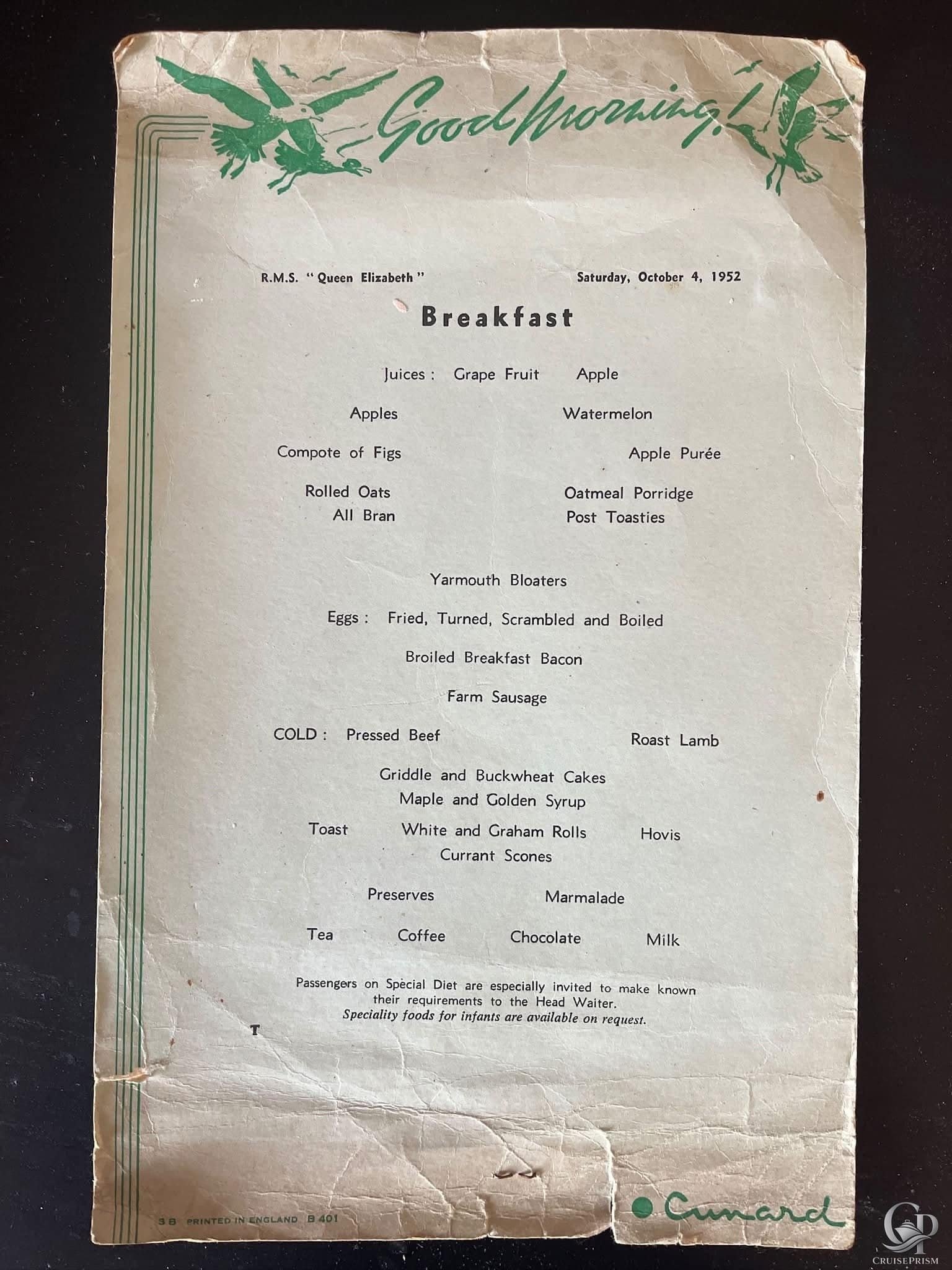
RMS Queen Elizabeth Breakfast Menu – October 4, 1952
Breakfast aboard Cunard’s RMS Queen Elizabeth in 1952 offered passengers an extensive selection of traditional British dishes, American breakfast favorites, fresh fruit, cereals, and freshly prepared breads.
An original Cunard breakfast menu dated Saturday, October 4, 1952, provides a fascinating glimpse into ocean liner dining during the golden age of transatlantic travel. From Yarmouth bloaters and pressed beef to buckwheat cakes with maple syrup, the menu reflects the culinary traditions that shaped passenger dining aboard one of the world’s most celebrated ocean liners.
The surviving document also features Cunard’s distinctive green artwork, including birds surrounding the words “Good Morning,” and offers an authentic example of how breakfast was presented to passengers more than seven decades ago.
CruisePrism readers planning a Cunard sailing can also explore our Cunard drink prices and bar menus, Cunard restaurant menus, and Cunard Onboard Guides for more information about dining, drinks, entertainment and onboard activities.
Original RMS Queen Elizabeth Breakfast Menu From October 4, 1952
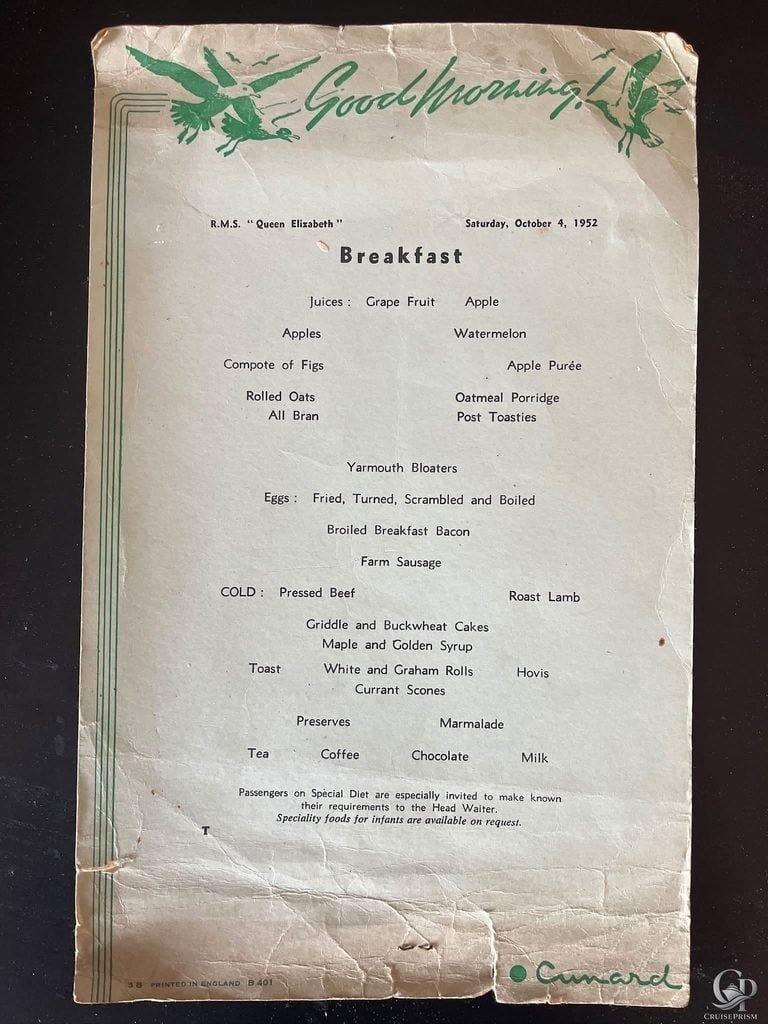
The original document identifies the vessel as R.M.S. “Queen Elizabeth” and is dated Saturday, October 4, 1952.
The menu has a decorative green border running along its left side, with stylized birds across the upper portion and the Cunard name printed at the bottom.
Its aged paper, visible folds, and worn edges reflect the physical condition of this surviving historical document.
Unlike modern cruise menus that may feature photographs, elaborate descriptions, and separate specialty dining options, this menu presents its selections in a relatively simple arrangement.
Nevertheless, the range of dishes is substantial, covering fruit, cereals, fish, eggs, meat, breads, preserves, and beverages.
The document does not identify the ship’s location, voyage number, or specific dining room, so these details cannot be established from the menu alone.
Breakfast Aboard RMS Queen Elizabeth in 1952
RMS Queen Elizabeth was one of Cunard’s great transatlantic ocean liners, entering commercial passenger service in 1946 after wartime service as a troopship.
Built by John Brown & Company at Clydebank, Scotland, the vessel operated alongside RMS Queen Mary on the North Atlantic.
At approximately 83,673 gross registered tons when completed, Queen Elizabeth was among the largest passenger ships of her era.
The ship’s role was different from that of a modern cruise vessel. Transatlantic liners primarily transported passengers between continents, with dining, accommodation, and onboard entertainment forming important parts of the crossing experience.
The October 1952 breakfast menu reflects this tradition, offering familiar British foods alongside dishes associated with American breakfast customs.
Fresh Fruit and Juices on the 1952 Breakfast Menu
The menu begins with fruit juices and fresh or prepared fruit.
The listed selections include:
- Grapefruit juice.
- Apple juice.
- Apples.
- Watermelon.
- Compote of figs.
- Apple purée.
These options demonstrate that breakfast was not limited to cooked dishes.
Passengers could begin their morning with fruit or juice before choosing something more substantial.
The inclusion of fig compote and apple purée is particularly interesting from a historical dining perspective. Both are examples of prepared fruit dishes that appeared alongside fresh selections on traditional hotel and ocean liner menus.
Cereals and Traditional Breakfast Grains
The menu includes several cereal options:
- Rolled oats.
- All Bran.
- Oatmeal porridge.
- Post Toasties.
This combination illustrates the mixture of British and American breakfast traditions represented aboard the ship.
Oatmeal porridge was a familiar hot breakfast dish in Britain, while packaged cereals such as All Bran and Post Toasties offered passengers alternative choices.
The presence of recognizable commercial cereal names also makes the document an interesting example of how branded food products appeared in mid-20th-century passenger dining.
Yarmouth Bloaters: A Traditional British Breakfast Dish
One of the most distinctive items on the menu is Yarmouth bloaters.
Bloaters are traditionally prepared from herring that has been salted and smoked. The name is particularly associated with Great Yarmouth, an English coastal town with a long history of herring fishing and processing.
Smoked fish was once a familiar part of traditional British breakfasts, particularly in hotels and established dining institutions.
Its appearance on this Cunard menu reflects a culinary tradition that is less commonly encountered on contemporary cruise ship breakfast menus.
For readers interested in historical British food, Yarmouth bloaters are one of the most revealing items on this document.
Eggs, Bacon, and Sausage
The cooked breakfast section offers several familiar choices.
Eggs are listed as:
- Fried.
- Turned.
- Scrambled.
- Boiled.
Additional cooked breakfast selections include:
- Broiled breakfast bacon.
- Farm sausage.
These dishes would still be recognizable to many cruise passengers today.
The wording is also worth noting. Rather than providing a separate description for every preparation, the menu simply identifies the available egg styles.
This concise presentation was consistent with the straightforward format used throughout the document.
Cold Meats and Breakfast Specialties
The menu includes a small section labeled “COLD,” offering two selections:
- Pressed beef.
- Roast lamb.
Cold meats were a recognized component of traditional breakfast and buffet service in earlier periods.
Pressed beef generally refers to cooked beef compressed into a firm preparation suitable for slicing and serving cold.
Roast lamb provided another savory alternative for passengers who preferred meat without ordering a conventional cooked breakfast.
Their inclusion helps distinguish this historical menu from many contemporary breakfast offerings.
Griddle Cakes, Buckwheat Cakes, and Syrup
The menu also features:
- Griddle cakes.
- Buckwheat cakes.
- Maple syrup.
- Golden syrup.
Griddle cakes are closely related to pancakes, while buckwheat cakes use buckwheat as a characteristic ingredient.
The availability of both maple and golden syrup is notable.
Maple syrup has a strong association with North American breakfast traditions, while golden syrup has long been familiar in British cooking.
Offering both illustrates how Cunard’s breakfast selections accommodated different culinary preferences.
The menu does not specify portion sizes or whether these dishes were prepared with additional toppings.
Breads, Rolls, Scones, and Preserves
The bakery selection is another interesting part of the document.
Listed items include:
- Toast.
- White rolls.
- Graham rolls.
- Hovis.
- Currant scones.
- Preserves.
- Marmalade.
Hovis is a longstanding British bread brand, while Graham bread takes its name from the whole-wheat flour associated with American dietary reformer Sylvester Graham.
Currant scones and marmalade are especially characteristic of British food traditions.
Together, these selections offered passengers a variety of lighter breakfast options alongside the cooked dishes.
The menu does not identify particular flavors of preserves or marmalade.
Tea, Coffee, Chocolate, and Milk
The beverage section lists four options:
- Tea.
- Coffee.
- Chocolate.
- Milk.
The wording is notably simple compared with modern cruise beverage menus.
There are no separate listings for espresso, cappuccino, flavored coffee, or specialty tea varieties.
The document also contains no individual beverage prices.
While the menu provides a record of the available selections, it does not independently establish whether breakfast was included in every passenger’s fare or how dining arrangements differed between accommodation classes.
Special Dietary Requirements and Infant Food
Near the bottom of the menu, Cunard includes an important passenger service notice:
“Passengers on Special Diet are especially invited to make known their requirements to the Head Waiter.”
A second statement explains that specialty foods for infants were available on request.
These details show that dietary accommodations were already part of Cunard’s passenger dining service in 1952.
Rather than listing separate dietary menus, the document directs passengers to communicate their requirements to the Head Waiter.
The reference to infant food also demonstrates that the ship provided for passengers traveling with young children.
However, the menu does not identify specific special diets, infant food products, or preparation procedures.
The Design of This Original Cunard Menu
Beyond its food selections, the document is valuable as an example of Cunard’s historical printed materials.
Several details stand out:
- A large handwritten-style “Good Morning” heading.
- Green bird illustrations across the top.
- A decorative green border along the left side.
- The ship’s name and exact date above the breakfast selections.
- The Cunard name printed at the lower right.
- Small printing information at the bottom indicating that the document was printed in England.
The arrangement combines decorative maritime-era design with a practical, easy-to-follow menu.
The surviving copy shows creases, discoloration, and wear, particularly along its edges and lower portion.
These characteristics are part of the document’s physical history and help distinguish it from a modern reproduction.
How This 1952 Cunard Breakfast Menu Compares With Modern Cruise Dining
The October 1952 menu provides an interesting point of comparison with contemporary cruise dining.
Many of its core selections remain familiar, including eggs, bacon, sausage, fruit, cereals, toast, and pancakes.
Other dishes, such as Yarmouth bloaters, pressed beef, and buckwheat cakes with golden syrup, give the menu a more distinctive historical character.
The document also reflects a different style of presenting food choices.
Instead of emphasizing specialty restaurants, branded dining experiences, or extensive descriptions, the menu organizes breakfast into straightforward selections.
It is important to remember that this is a single breakfast menu from one date. It does not establish what was served throughout the voyage or across every dining room aboard the ship.
Frequently Asked Questions About the RMS Queen Elizabeth 1952 Breakfast Menu
What date is the original Cunard breakfast menu from?
The menu is dated Saturday, October 4, 1952.
Which ship served this breakfast menu?
The document identifies RMS Queen Elizabeth, Cunard’s historic transatlantic ocean liner.
What breakfast foods were available aboard RMS Queen Elizabeth?
The photographed menu includes fresh fruit, juices, cereals, Yarmouth bloaters, eggs, bacon, sausage, cold meats, griddle cakes, buckwheat cakes, breads, scones, and beverages.
What are Yarmouth bloaters?
Yarmouth bloaters are traditionally salted and smoked herring associated with Great Yarmouth in England. They were historically served as a savory breakfast dish.
Were pancakes available on the 1952 menu?
The menu lists griddle cakes and buckwheat cakes, accompanied by maple and golden syrup.
Did Cunard accommodate special diets in 1952?
The document specifically invites passengers with special dietary requirements to inform the Head Waiter. It also states that specialty foods for infants were available on request.
Does the menu show breakfast prices?
No. The photographed menu does not display individual prices for its food or beverage selections.
Was this menu used during a transatlantic crossing?
RMS Queen Elizabeth operated as a transatlantic ocean liner during this period, but the menu itself does not identify the specific voyage or route on October 4, 1952.
Is this a menu from the modern Queen Elizabeth cruise ship?
No. This document belongs to the original RMS Queen Elizabeth, the historic Cunard ocean liner. It should not be confused with Cunard’s modern Queen Elizabeth, which entered service in 2010.

Conclusion
This original RMS Queen Elizabeth breakfast menu from October 4, 1952, offers a remarkable glimpse into passenger dining aboard one of Cunard’s most famous ocean liners.
Its combination of traditional British dishes, American breakfast favorites, fresh fruit, cereals, and baked goods demonstrates the variety available to passengers during the early postwar era of transatlantic travel.
Details such as Yarmouth bloaters, pressed beef, golden syrup, and the special dietary notice make the document particularly interesting for maritime historians and collectors of vintage cruise and ocean liner memorabilia.
More than seven decades later, this surviving Cunard menu remains a tangible record of the food, service, and presentation that helped define the classic ocean liner experience.